

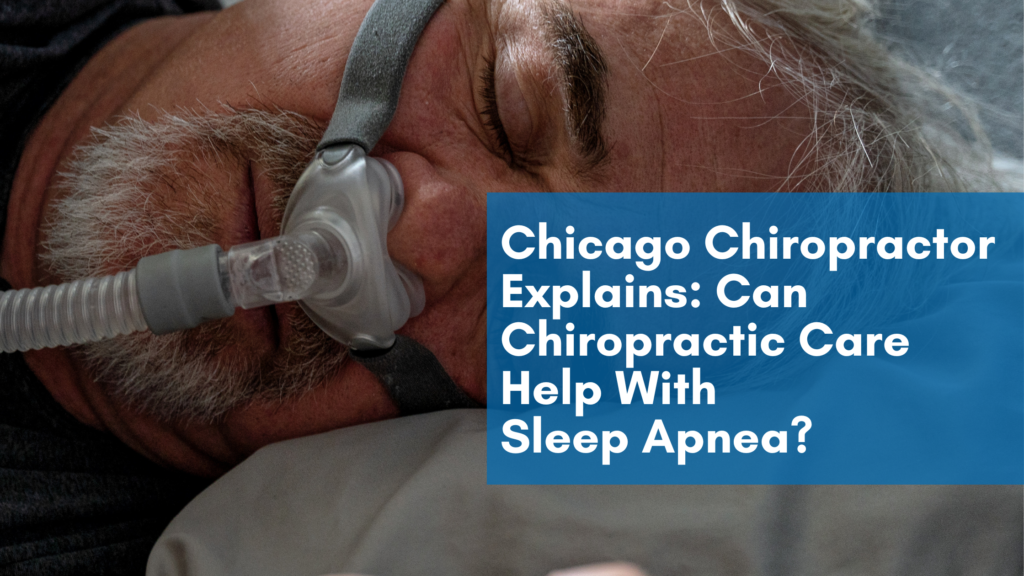

Misalignments in this area can profoundly impact the nerves that control breathing muscles and shift the delicate structures of the upper airway, contributing to the restricted airflow that defines sleep apnea. This is why a chiropractor is a crucial, relevant piece of your overall wellness plan.
What Is Sleep Apnea?
Sleep apnea is a common, yet serious, sleeping disorder characterized by repeated pauses in breathing or shallow breaths while you sleep.
These interruptions in sleep can last from a few seconds to minutes and may occur 30 times or more per hour. Each cessation causes your brain to briefly wake you up to restart breathing, leading to severely fragmented and non-restorative sleep.
How Can Holistic Chiropractic Treatments Help With Sleep Apnea?
The answer to ‘How‘ chiropractic care assists with sleep apnea centers on a holistic treatment plan that directly addresses the musculoskeletal components (like spinal misalignment and poor posture) often overlooked by traditional therapies. Instead of solely masking the symptom of interrupted breathing, our goal is to improve the function of the body’s natural breathing mechanism.
By focusing on alignment, muscle tension, and nervous system regulation, we help ensure your airway remains open, robust, and supported. This comprehensive, whole-body strategy works to reduce the frequency and severity of apneic events, setting the stage for genuinely restorative sleep.
Chicago-based chiropractors at Advanced Spine & Sports Care can help with sleep apnea using various treatments such as soft tissue therapy, posture retraining, mobilization, and even spinal decompression. It also depends on how severe your sleep apnea is, whether it’s obstructive or complex/mixed apnea.
When you’re looking for a sleep apnea chiropractor in the Lakeview & Lincoln Park area, ASSC chiropractic treatment can definitely help improve your sleeping position & posture, through holistic chiropractic therapies.
Explore Which Chiropractic Treatment Therapies Are Best for Improved Sleeping
You’ll discover comprehensive answers to these important questions:
-
- What are the main causes of Sleep Apnea (focusing on structural and lifestyle factors)
- Which chiropractic treatments work best for managing sleep apnea symptoms
- When chiropractic care helps and when it doesn’t, or needs concurrent medical treatment
- How does chiropractic care compare to other treatments (like Yoga, Physical Therapy, Cognitive Behavioral Therapy (CBT), and nutritional supplement plans)
What Causes Sleep Apnea?
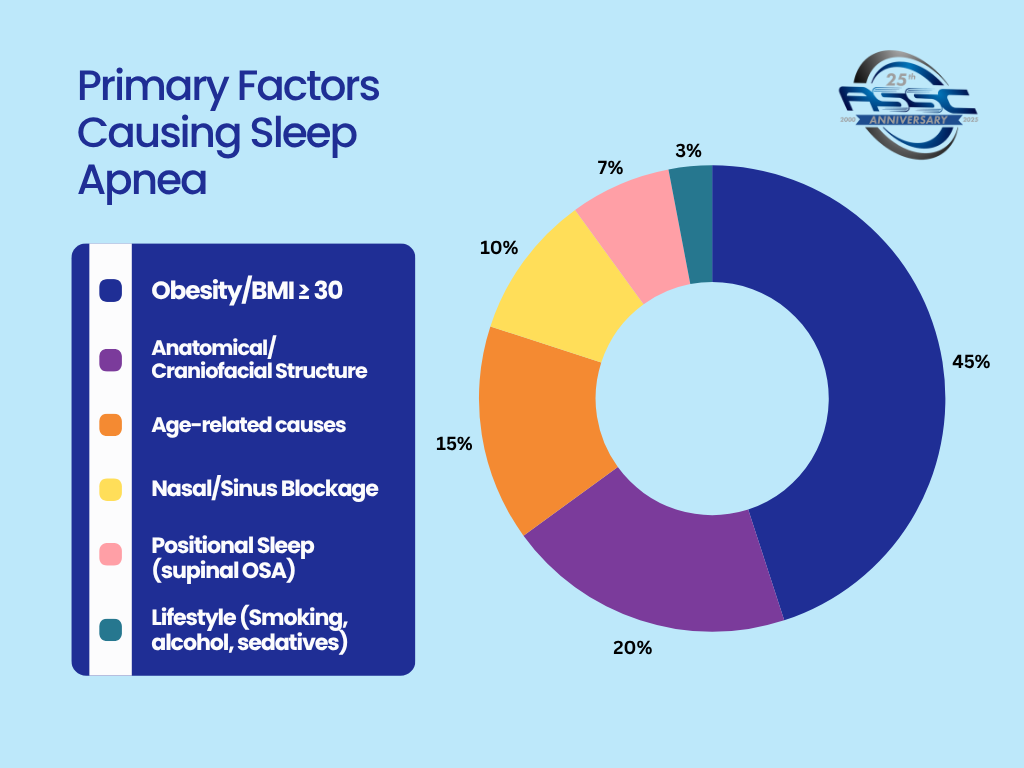
Primary Contributing Factors: Sleep Apnea Types & Statistics
A recent study revealed that obesity ranked the highest risk factor for sleep apnea.
Is this a direct correlation? The studies suggest so, but it’s not the only one.
Anatomical structure (having a narrow jaw for example), can obstruct the airways. Even age is a contributing factor.
Still, sleep apnea is a condition that develops gradually, so it’s not only one factor that causes apnea.
Structural, neurological, and lifestyle factors also change the way air moves through your upper airway.
Sleep Apnea Types
There are three main sleep apnea types:
- Obstructive Sleep Apnea (OSA) – the airway physically collapses during sleep.
- Central Sleep Apnea (CSA) – the brain temporarily stops sending signals to breathe.
- Complex / Mixed Apnea – a combination of both.
For most adults, OSA is the main culprit, and that’s the type sleep apnea chiropractors can often help with.
A Closer Look At the Causes of Sleep Apnea
Sleep apnea happens when breathing repeatedly stops or becomes shallow during sleep.
You’ve probably noticed one or two of the symptoms already:
- Loud, chronic snoring
- Morning headaches
- Daytime fatigue or “brain fog”
- Gasping or choking during sleep
- Neck or jaw tightness
Main Contributing Factors of Sleep Apnea Conditions & Disorders
If you’ve ever wondered why these symptoms happen, there’s a good explanation for all of this.
| Factor | How It Leads to Sleep Apnea |
| Anatomy & Structure | A narrow jaw, forward head posture, or misaligned cervical spine can shorten throat space and make the airway more collapsible. |
| Muscle Weakness or Tension | Over time, weak tongue and throat muscles or tight neck and jaw tissues allow the airway to sag or tighten during sleep. |
| Weight Gain | Excess tissue around the neck and diaphragm adds pressure to the airway, making it harder to stay open at night. |
| Age & Gender | As we age, muscle tone declines, especially in the neck and upper airway. Men are generally more prone, but women after menopause are also at risk. |
| Sleeping Position | Sleeping on your back (supine) allows gravity to pull the jaw and tongue backward. |
| Nasal Blockage & Allergies | Chronic congestion, deviated septum, or sinus inflammation increases airway resistance. |
| Spinal & Postural Issues | Rounded shoulders, slumped chest, or forward head posture compress the rib cage and throat, creating a structural airway limitation. |
| Alcohol, Sedatives, & Smoking | These relax airway muscles and decrease responsiveness to oxygen changes. |
How A Chiropractor Can Help With Sleep Apnea
Chiropractic treatment focuses on posture correction, chest expansion, and restoring your spine’s natural curve.
Correcting these areas promotes better or improved airflow.
Why do these matter?
Take Jerry as an example.
Jerry works a 9 to 5 job. He crunches numbers 60+ hours a week and sits in front of a computer more than half the time.
Jerry doesn’t pay attention to posture. For him, this is a small sacrifice to pay to fulfill his job requirements.
But what Jerry doesn’t realize is that every time his head juts forward, it narrows the airway by several millimeters.
This sounds harmless, but if you consider all the factors we mentioned above (anatomical changes, muscle weakness, tight jaw muscles, or even a restricted rib cage), slowly over time, Jerry can develop sleep apnea.
Sounds ridiculous?
Your airway isn’t just soft tissue. It’s framed by the spine, ribs, and jaw.
If these structures are tight, misaligned, or under tension, they can influence breathing during sleep.
In fact, any pressure on your cervical spine affects your sleep too.
Trouble Sleeping? Ways Chiropractic Helps Improve Sleeping Conditions
Ways Chiropractic Care Helps Sleeping (Conditions & Disorders)
Even old injuries (whiplash, TMJ trauma, sports injury) can slowly distort alignment over time.
And when you neglect treatment, apnea can lead to heart disease, high blood pressure, and metabolic issues.
That’s where chiropractic care, spinal decompression, and posture correction come into play. By restoring proper cervical curve and chest expansion, the airway can function the way it’s meant to.
How Sleep Apnea Chiropractic Treatment Can Improve Your Sleep
Chiropractic care aims to restore movement, alignment, and neuromuscular balance in these areas.
Here’s the biomechanical breakdown and a quick overview of what you can expect from sleep apnea chiropractic treatment.
| Area | What Goes Wrong | How Chiropractic May Help |
| Cervical Spine (Neck) | Forward-head posture shortens airway space; disc pressure can affect the nerves | Gentle adjustments and spinal decompression can realign vertebrae and reduce compression on airway-supporting tissues. |
| TMJ & Jaw Alignment | Tight jaw muscles pull the mandible backward, narrowing the throat. | TMJ-aware adjustments and soft-tissue therapy restore natural jaw motion |
| Rib Cage & Diaphragm | Restricted ribs reduce chest expansion and diaphragm movement. | Mobilization and posture retraining restore full breathing mechanics and chest expansion. |
| Nerve Interference | Nerve irritation affects throat muscle tone. | Decompression and mobilization may improve coordination of airway muscles. |
| Postural Reflexes | Rounded shoulders and weak neck stabilizers may lead to airway collapse during sleep. | Strengthening and ergonomic coaching maintain open-airway alignment. |
The best approach is to combine airway-focused chiropractic adjustments with breathing retraining and posture work.
This often improves comfort, reduces snoring, and helps patients tolerate CPAP or oral appliances better.
Can Spinal Decompression Help?
Spinal decompression therapy can help and should be considered a supplementary treatment.
How does it work?
By using gentle traction (at ASSC, we perform this through our DRX9000) to relieve disc pressure and nerve irritation in the cervical spine.
For some patients, this can:
- Improve neck posture
- Reduce tension in airway-supporting muscles
- Alleviate discomfort that worsens sleep positions
While research is still limited, decompression may complement other airway treatments by improving structural support for the upper airway.
When Chiropractic Helps (and When It Doesn’t)
Think of chiropractic care as an adjunctive treatment.
It has a role to play in treating sleep apnea, but also has its own limitations depending on the intensity and complexity of the condition.
| Chiropractic Care is Most Effective When… | It’s Not the Right Fit When… |
| Sleep apnea is mild or moderate. | Sleep apnea is severe or central (brain-origin). |
| The patient struggles with CPAP comfort or jaw tension. | There’s no mechanical or postural component to the apnea. |
| Posture, TMJ, or rib restrictions are present. | The patient hasn’t yet seen a sleep physician or had a sleep study. |
Chiropractic vs. Other Sleep Apnea Treatments
If you’ve ever searched for “sleep apnea chiropractor near me”, most of the answers you’ll get lean towards posture therapy, TMJ or physical therapy, and if possible, spinal decompression.
CPAP is the most common treatment, and also one that many default to.
That said, some treatments target specific symptoms or concerns that may help improve your condition holistically.
| Treatment | What It Does | Best For | Strengths | Limitations |
| CPAP (Continuous Positive Airway Pressure) | Keeps the airway open with pressurized air. | Moderate–severe apnea. | Gold-standard effectiveness. | Can feel uncomfortable or claustrophobic. |
| Custom Oral Appliance | Advances jaw to open airway. | Mild–moderate apnea or CPAP intolerance. | Portable, noninvasive. | Requires dental fitting; possible jaw soreness. |
| Myofunctional Therapy | Trains tongue/throat muscles. | Mild–moderate apnea, adjunct therapy. | Evidence-backed for snoring reduction. | Requires daily exercises. |
| Surgery (ENT or Inspire®) | Alters anatomy to widen the airway. | Structural obstructions or severe apnea. | Potentially curative in select cases. | Invasive, variable success. |
| Airway-Focused Chiropractic (ASSC) | Corrects posture, rib, jaw, and neck mechanics. | CPAP-intolerant or mild apnea. | Improves comfort, posture, and breathing patterns. | Adjunctive; not a standalone cure. |
Top Alternative Sleep Apnea Treatments
*Ranked for Effectiveness
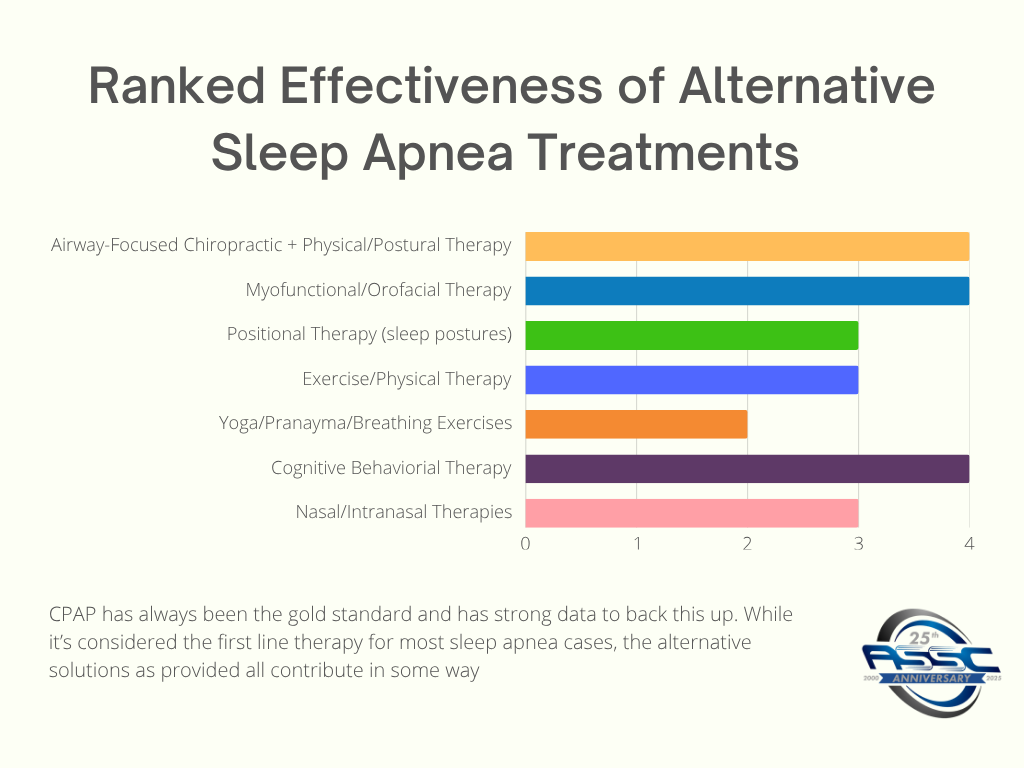
Top-Rated Sleep Apnea Alternative Treatments
- Holistic Chiropractic (Postural Correction & Alignment): Sleeping Position Therapy
- Nasal & Myofunctional/Orofacial Therapies
- Cognitive Behavioral Therapy
- Exercise & Physical Therapy
- Yoga Breathing Exercises
Some of the core highlights from each of the studies showing the effectiveness of each sleep apnea treatment are as follows:
- Sleep apnea and overall health improved by combining chiropractic care (specifically chiropractic adjustments) with orofacial therapy, physical therapy, nutritional modification, and postural correction
- Myofunctional therapy decreased Apnea Hypopnea Index (AHI) by 50% in adults leading to better sleep outcomes, less snoring, and lower oxygen saturations
- Positional therapy is effective for managing OSA but not as effective as CPAP if the goal is to reduce AHI and improve oxygenation
- Patients with limited physical activity are at a higher risk than patients who engage in regular exercise
- Yoga, Pranayama, and breathing exercises promote better quality of life, specifically for breathing regulation, metabolism, and reduces cardiovascular morbidity.
- Combining Positive Airway Pressure (PAP) therapy with Cognitive Behaviorial Therapy (CBT) not only proved effective for sleep apnea but also improved daytime functioning
- Intranasal therapy didn’t reduce AHI but can be used as an effective treatment for managing symptoms or providing relief
Other Natural or Alternative Treatment Therapies for Sleep Apnea
Are there “natural ways” to help sleep apnea?
Interestingly, there are a few, and according to Sleep Foundation, even remedies like acupuncture and regular exercise can provide benefits.
Even increasing your Vitamin D might help, as research shows there’s a pattern of patients having a Vitamin D deficiency linked to sleep apnea.
While the studies are new, this isn’t too far a stretch seeing as how vitamin deficiencies are also linked to sciatica.
Overall, take each natural remedy not as a cure-all or permanent solution, but a lifestyle adjustment to prevent sleep apnea from becoming worse.
Here are a few ideas to help get you started:
| Alternative | What It Is | Evidence | How It Works with Chiropractic |
| Yoga & Breathing Exercises | Controlled breathing and postures. | Mild evidence for improved oxygenation. | Complements chiropractic diaphragm and rib work. |
| Weight Loss & Exercise | Reduces neck and chest fat. | Strong evidence for mild–moderate OSA improvement. | Chiropractic improves movement and posture to support exercise. |
| Positional Therapy | Keeps you from sleeping on your back. | Helpful for “positional OSA.” | Easier when posture and neck mechanics improve. |
| Myofunctional Therapy | Tongue/throat exercises. | Meta-analyses show benefit for mild–moderate OSA. | Often prescribed alongside chiropractic and dental appliance care. |
| Cognitive Behavioral Therapy (CBT) | Improves insomnia and anxiety around sleep. | Excellent for sleep quality. | Addresses mental stress while chiropractic handles physical factors. |
| Nasal Sprays & Allergy Care | Improves nasal airflow. | Helps CPAP comfort. | Chiropractic adds rib and neck mobility for easier breathing. |
| Supplements / Herbs | Melatonin, magnesium, etc. | Helps general sleep, not apnea directly. | Works for relaxation, not airway correction. |
Apart from all the natural remedies listed here, choosing the right pillow for sleep makes a huge difference.
Verdict: Can a Chiropractor Help With Sleep Apnea?
Absolutely, but not alone.
The most effective results come from combining medical, mechanical, and natural care:
(Medical + Mechanical + Behavioral/Natural = Sustainable Relief)
Chiropractic sits in the mechanical zone, helping your body function better alongside your sleep physician’s plan.
Chiropractic Care The Holistic Link: Calming the Nervous System for Restorative Sleep + Overall Wellness & Stress Relief.
Holistic Wellness Chiropractors in Chicago
Advanced Spine & Sports Care Treatment Therapies- (Located Near You in Lakeview/Lincoln Park)
- Postural rehabhttps://chiropracticsportscare.com/chicago-chiropractors-near-lakeview-lincoln-park/
- Cervical decompression
- Gentle spinal adjustments
- Gentle spinal adjustments
- TMJ and soft-tissue therapy
- Diaphragm and rib mobility work
Holistic Chiropractic for Nervous System for Restorative Sleep & Overall Wellness & Stress
How Do I Locate A Holistic Chicago Chiropractor That Treats Sleep Conditions?
Serving the North Side of Chicago and Neighboring Communities
Finding convenient and effective care for sleep apnea is essential. Our Chicago Chiropractic spinal wellness clinic is located on the North Side and is dedicated to providing specialized, holistic chiropractic treatments. We understand the health challenges facing our community and offer flexible appointments to help you finally get the restful sleep you deserve.
Can a chiropractor help with sleep apnea?
Yes a chiropractor can help with sleep apnea especially if it’s combined with proven effective treatments such as postural correction, myofunctional therapy, and physical therapy. Chiropractic care improves airway mechanics and posture, helping CPAP or dental devices work more comfortably. To learn more, contact a sleep apnea chiropractor to discuss a tailor-fit plan.
Is spinal decompression safe for sleep apnea patients?
Spinal decompression is safe when performed by a licensed chiropractor. In ASSC, we use the DRX9000 for spinal decompressing. Unlike the traditional spinal traction method, spinal decompression is more gentle and aims to relieve cervical pressure that could worsen airway tension.
Can posture correction reduce snoring?
Yes posture correction can help in reducing snoring or managing sleep apnea symptoms. A forward head or rounded shoulders can shorten throat space. Restoring alignment can make breathing easier, especially when combined with myofunctional or medical therapy.
Will chiropractic replace my CPAP?
No, chiropractic care won’t necessarily replace CPAP but if combined with other treatments, it can lead to a reduced need or dependence on CPAP.
See Related Articles for Improved Sleep Quality & Treatment of Sleeping Conditions in Chicago
Top Tips to Improve Sleep with Neck & Shoulder Pain Conditions
Sleep Apnea Chiropractor in Lakeview/Lincoln Park, Chicago
If you’ve tried CPAP and other forms of treatment in the past, talking to a chiropractor can help you understand your condition more along with finding treatments to improve sleep apnea overall.
Call Advanced Spine & Sports Care at 773-868-0347 today or schedule your appointment directly on our website. We are conveniently located to serve the North Side and surrounding neighborhoods, including Wrigleyville, Lakeview, Roscoe Village, Lincoln Park, Logan Square, Wicker Park, and Bucktown.
Last Updated on October 27, 2025 by Chiropractor Dr. Jason Ingham DC, CCSP