


Patients in Lincoln Park have asked us, “Does a chiropractor help headaches?”, and the honest answer is: it depends on which kind you have.
Chiropractic care has science-based, guideline-backed support for neck-related headaches. For migraines, a chiropractor can aid in providing support but not as the main treatment. For patients experiencing ordinary tension headaches, specialized care isn’t always necessary.
Chiropractic Treatment for Headache Pains
Before seeking any professional treatment, first we need to check whether you’re dealing with a cervicogenic headache, migraine, or tension.
This guide breaks down which is which and how to spot where your headache is coming from. It also covers when a chiropractic evaluation is worth scheduling.
How Does a Chiropractic Care at ASSC Help Relieve Headaches?
Not all headaches respond to chiropractic care the same way. The type matters more than most clinics will tell you.
- Cervicogenic headaches (neck-related): Strong support. National guidelines specifically recommend spinal adjustments for headaches that start in the neck.
- Migraine: Moderate support. Adjustments plus other care like massage carry a similar recommendation.
- Tension headaches: Weakest support. Guidelines can’t recommend adjustments for episodic tension headaches. Evidence is mixed for chronic ones. Gentle mobilization may help longer term, but it’s not the same strong recommendation.
You might’ve read that chiropractic care can treat tension headaches but the data around it isn’t certain or as strong compared to cervicogenic headaches. The reason being, that tension in the head can also come with other symptoms such as fever, nausea, etc. This means a one-size-fits-all solution would be ineffective in treatment.

How to Tell If Your Headache Is Coming From Your Neck
Signs your headache may be coming from your neck:
- Pain that’s worse on one side and stays on that side
- A history of neck strain, whiplash, or long hours at a desk
- Pain that gets worse with certain neck movements or positions
- Pain that starts at the base of your skull or neck and spreads forward
- Reduced neck range of motion, or stiffness that comes with the headache
Signs it may not be neck-related:
- Pain that comes in intense clusters around one eye
- Pain on both sides of your head, feeling like a tight band
- Throbbing pain with nausea, light sensitivity, or visual changes
- No connection between neck movement and headache intensity
Neither of these signs means a complete diagnosis. Treat them as a starting point during your consultation or evaluation with a chiropractor or doctor, especially if your pattern doesn’t cleanly match either column.
Cervicogenic vs. Tension vs. Migraine: Why the Type of Headache Affects Treatment
Think of a garden hose with a kink in it.
Water sprays out oddly at the nozzle, but the actual problem isn’t the nozzle at all. It’s the kink further back in the hose. Fixing the nozzle wouldn’t do anything, because that was never where the problem was.
Cervicogenic headaches work the same way.
The pain shows up in your head, but the actual problem is in your neck’s joints, muscles, or nerves. It’s a downstream symptom of an upstream issue.

Tension headaches and migraines are different. They’re more like a problem with the hose itself, right where the water’s coming out.
Tension headaches usually come from muscle tightness and stress, spread across both sides of the head. Migraines involve changes in brain activity and blood vessels, often with nausea or light sensitivity layered on top. That’s why treatment isn’t one-size-fits-all. Fixing the “kink” in your neck doesn’t help if your headache was never coming from there.
What the Research Actually Shows
Key takeaways from research:
- Cervicogenic (neck-related) headaches have the strongest evidence. National guidelines specifically recommend spinal adjustments for this type, backed by newer studies showing real, if modest, short-term improvement.
- Migraine has real support too. Tension headaches don’t. Adjustments plus other care like massage are recommended for migraine. Guidelines can’t recommend adjustments for episodic tension headaches at all, despite tension headaches being what most clinics advertise first.
- The evidence is promising, not proven. A recent review found overall certainty still low, with most trials carrying some risk of bias.
National guidelines from the chiropractic field’s own evidence review are clear on one thing .Spinal adjustments are recommended for cervicogenic headache. Joint mobilization and neck exercises also show benefits.
For a migraine, adjustments plus other care like massage carry a similar recommendation. Tension headaches are different. The evidence doesn’t support the same conclusion, and episodic tension headaches specifically aren’t recommended for adjustments at all.
Newer research adds some nuance worth knowing: review of seven trials found adjustments produced small but real short-term gains. Pain and frequency both improved for neck-related headaches. A separate review pooled 20 studies covering more than 1,400 patients with cervicogenic headache. It found moderate-to-large short-term benefits for headache frequency and intensity when manual therapy was compared against sham treatment. Most of that benefit showed up early.
A more recent review adds nuance worth knowing. National guidelines from the chiropractic field’s own evidence reviews are clear: spinal adjustments are recommended for cervicogenic headaches. Joint mobilization and targeted neck exercises also show significant benefits.
Benefits of Chiropractic Care for Headaches and Migraines
The Benefits of Chiropractic Care for Headaches and Migraines
When Chiropractic Care Won’t Fix Your Headache
Chiropractic care isn’t the right tool for every headache. A good chiropractor will tell you that upfront.
If your headaches come with fever, that’s not a job for a spinal adjustment. Neither is sudden severe pain unlike anything you’ve felt before. The same goes for neurological symptoms like slurred speech or numbness.
Cluster headaches also fall outside what chiropractic care is built to treat. So do headaches from sinus infections or medication overuse. Ruling these out first is part of responsible care always.
Red Flags: When a Headache Needs Urgent Medical Attention
Some headaches need a doctor or emergency room, not a chiropractor.
Seek prompt medical attention if your headache is sudden and severe, unlike any you’ve had before. The same goes for a headache following a head injury.
Fever, a stiff neck, confusion, weakness, numbness, or trouble speaking are also reasons to seek care right away. These symptoms can point to something more serious than a mechanical neck issue. A responsible chiropractor will refer you out rather than treat first and ask questions later.
Chiropractic Treatment for Headaches Near Lincoln Park & Lakeview
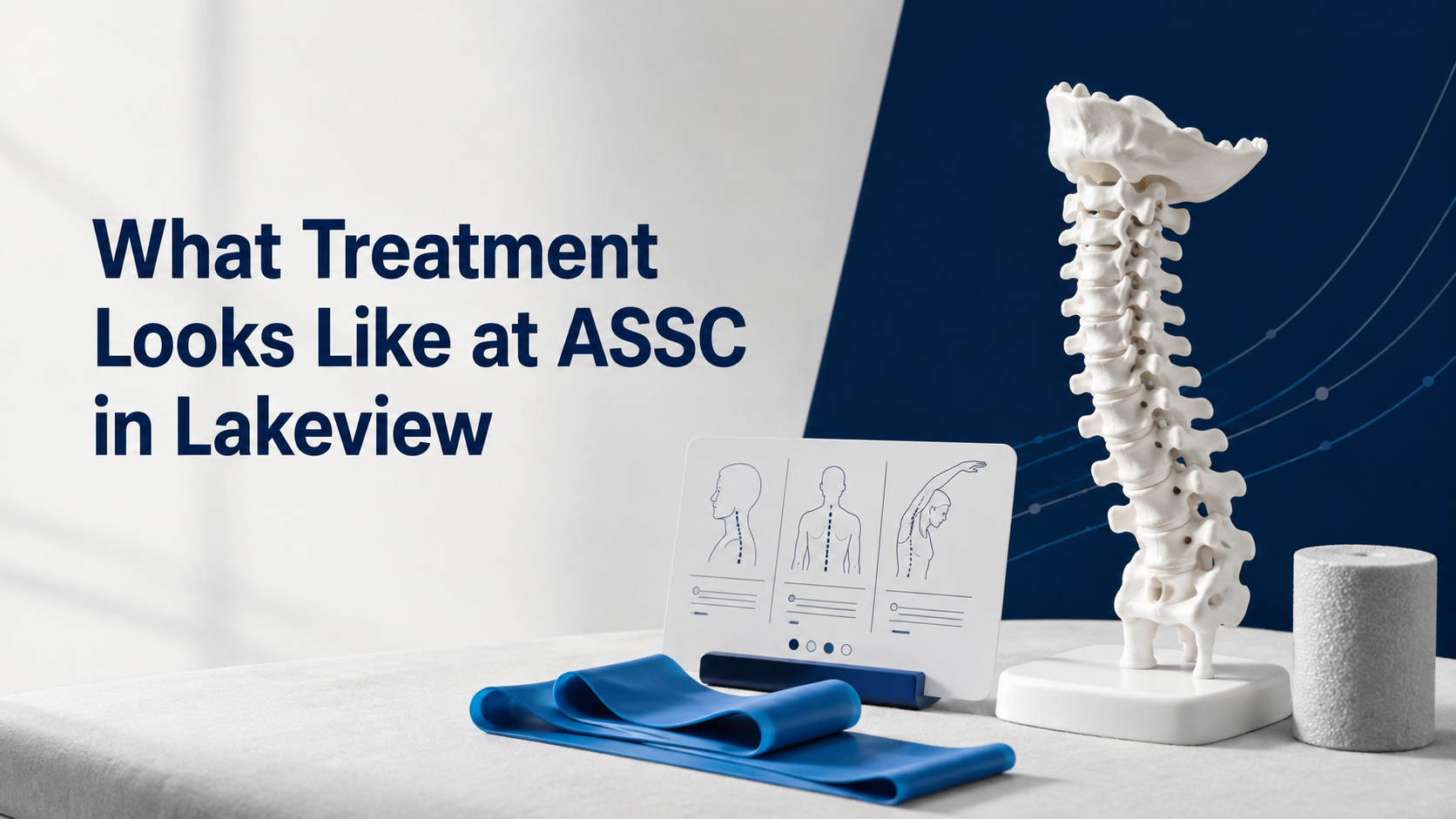
Dr. Jason Ingham, a Certified Chiropractic Sports Physician with more than 25 years treating Chicago patients, looks at these questions before recommending any treatment plan. From there, care might include chiropractic adjustments, soft tissue work, or targeted exercises, depending on what’s actually driving your pain.
Patients across Lakeview, Lincoln Park, and Wrigleyville come in after months of guessing at over-the-counter fixes.
Headache Treatments at ASSC
At Advanced Spine & Sports Care, treatment starts with understanding your headache pattern.
- Where does it start?
- What makes it worse?
- Does your neck’s movement and posture line up with a cervicogenic pattern?
A proper evaluation is often the first time anyone has actually looked at the neck as a possible source. If your headaches keep returning despite trying the usual remedies, that’s worth a closer look. Scheduling a consultation is a low-pressure way to find out whether your neck is part of the picture.
Chiropractic Treatment for Headaches (FAQs)
Is Spinal Manipulation for Headaches Safe?
Spinal manipulation for headaches is generally regarded as a safe procedure. The research reviewed for the national chiropractic guidelines found that adverse events were rarely reported in clinical trials. When they were reported, they tended to be minor.
What Are the Side Effects of Getting Chiropractic Treatment for Headaches?
Most side effects are mild and short-lived.
Feeling a little sore or tired after an adjustment is common, and it’s usually nothing to worry about. A mild headache can sometimes follow treatment too, along with occasional lightheadedness right after a session. These effects typically resolve within 24 to 48 hours on their own.
Serious complications are rare, and they’re far less likely when treatment comes from a licensed, experienced provider. That’s part of why choosing a qualified chiropractor, not just any provider, matters as much as the treatment itself.
How Long Does It Take to Feel Relief?
Some patients notice a difference after the first visit or two. That’s especially true for neck-related headaches with an accurate diagnosis. Others need several weeks of consistent care before frequency or intensity meaningfully drops.
Overall, it depends on how long the underlying neck issue has been building, and how your body responds to treatment.
Can Chiropractic Care Prevent Migraines, Not Just Treat Them?
There’s guideline support for chiropractic care as part of migraine management, not just symptom relief during an attack. That typically means adjustments combined with other approaches like massage.
It works best used consistently, not just when a migraine hits. It’s not a guaranteed prevention method, but it’s recognized as a reasonable part of a broader migraine management plan.
Do I Need a Referral to See a Chiropractor for Headaches in Lincoln Park?
In most cases, no. You can typically schedule directly with a chiropractor for a headache evaluation without a referral from another doctor. Or if you feel more comfortable getting all your answers first, you can contact our clinic and get a response within the day before committing to a consultation.
Receiving The Best Chiropractic Treatment for Your Headaches
An ASSC chiropractor can help with headaches, specifically, for neck-related pain, and a case-to-case basis for migraines and/or tension headaches. If your headaches keep coming back and the cause is unclear, understanding your options is often the first step.
A consultation at ASSC in Lincoln Park can help clarify whether your neck is playing a role. From there, you’ll have a clearer sense of what a reasonable next step looks like.
Last Updated on August 11, 2026 by Chiropractor Dr. Jason Ingham DC, CCSP