

Lincoln Park Working Professional Life Hacks
Ergonomic Tips For Neck & Back Pain Relief & Stretching Exercise Videos to Improve Spinal Wellness, to Know Best:
- How you sleep
- How you stretch
- How often you move
- How you set up your desk
- How to tell when the pain needs more than a better chair.
Common Causes of Neck & Back Pain, Lincoln Park Working Professionals Develop
Back pain rarely begins because of one bad movement.
Instead, it develops from thousands of small movements repeated every day.
Common causes of neck & back pain include:
- Sitting for prolonged periods
- Leaning toward a laptop
- Looking downward at multiple monitors
- Crossing your legs
- Slouching in your chair
- Weak glute muscles
- Tight hip flexors
- Limited thoracic mobility
- Poor core stability
When these movement patterns continue day after day, your body begins compensating. Those compensations often create inflammation, muscle guarding, and excessive stress on the spinal discs. If you work from a desk environment in Lincoln Park, or anywhere else in Chicagoland, these are the changes worth making 1st.
5 Ergonomic Tips For Neck & Back Pain Relief
Most people notice a difference within the first week or two. These 5 ergonomic tips for back pain relief cover the changes that matter most:
1. Set Up Your Chair and Desk the Right Way
Your feet should rest flat on the floor, with your knees at roughly a 90-degree angle.
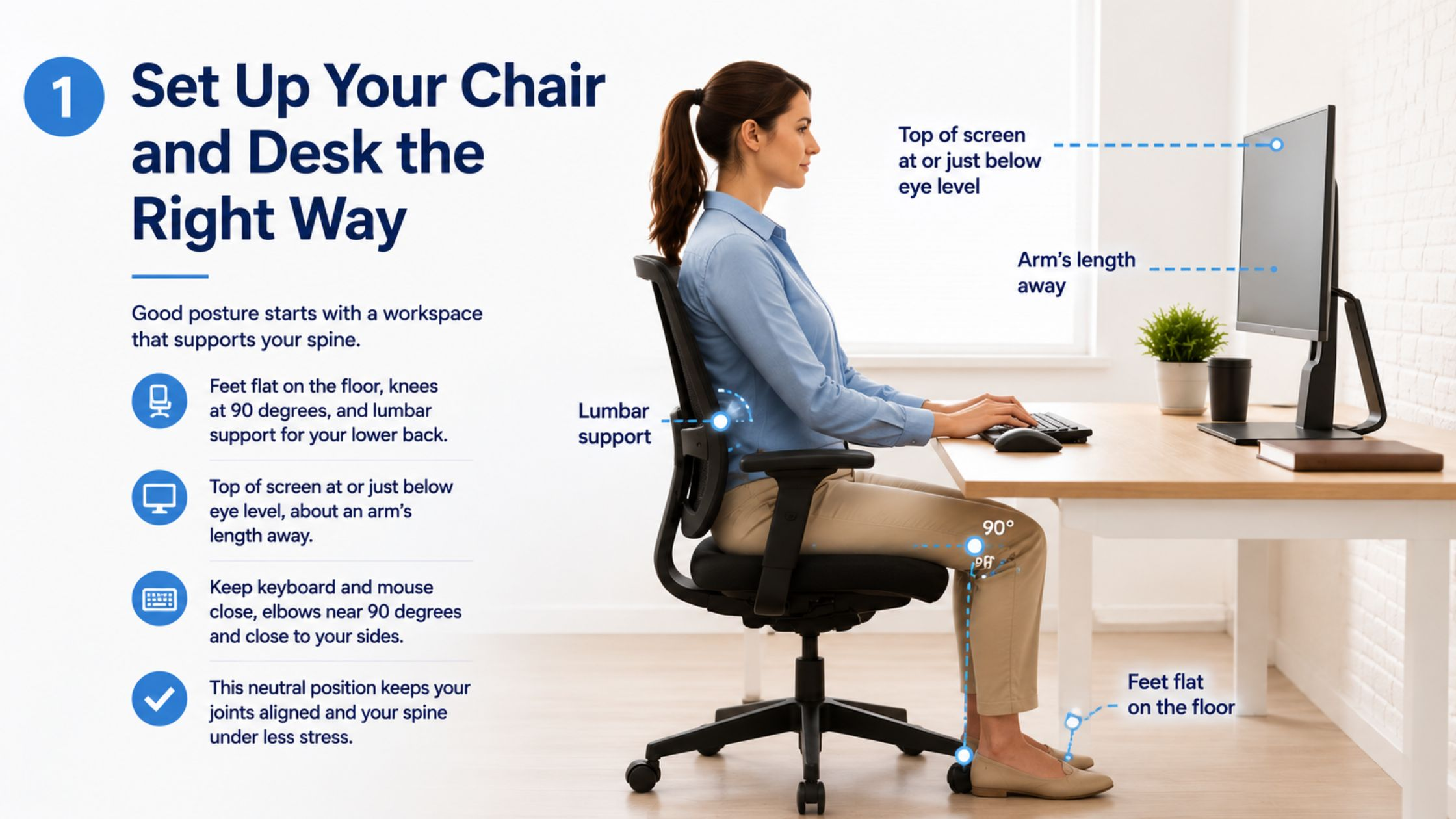
If your chair doesn’t offer real lumbar support, a small pillow or rolled towel behind your lower back can stand in for it. From there, check your monitor. The top of the screen should sit at or just below eye level, about an arm’s length away. That keeps you from tipping your head forward or craning your neck just to see it.
Keyboard and mouse placement also matters and plays a role in spinal alignment.
Keep them close enough that your elbows stay near your sides, bent around 90 degrees, instead of reaching forward. The Occupational Safety and Health Administration calls this a neutral body position, where your joints stay naturally aligned and your muscles and spine carry minimal stress.
The Truth About Tech Neck
Take a moment to think about how many hours you spend on your phone, tablet, or computer each day. Whether you’re scrolling through social media, replying to work emails, or binge-watching your favorite show, chances are, you’re looking down at a screen for a significant portion of your day.
When constantly tilting your head forward, your neck muscles, ligaments, and spine are forced to work overtime to support the unnatural position. This repetitive strain can lead to discomfort and even structural changes in your spine if left untreated.
While technology has brought incredible convenience, it’s also created a modern health issue that affects people of all ages: Tech Neck, also known as Text Neck. Tech Neck is the result of prolonged forward head posture, usually caused by looking down at screens.
Does Poor Posture Cause Spinal Misalignment? Expert Insights & Solutions
2. Stretch Your Lower Back Throughout The Day
A few gentle movements, done consistently, go a long way toward loosening a tight lower back and providing back pain relief.
- Try a seated spinal twist: sitting upright, gently rotate toward one side while holding the back of your chair, then switch sides.
- A standing forward fold can also help. Let your upper body hang loosely toward your feet for a few breaths, and let gravity do the work.
None of this needs to be intense. The goal is simply to move your spine through its normal range of motion, not to push through discomfort. A minute or two, done a few times throughout the day, tends to matter more than one long stretch session in the evening.
Here are several more stretching exercises you can do, from upper body and neck pain relief to spine exercises:
5 Spinal Wellness Videos for Working Professionals:
Stretching Exercises for Upper Body Stiffness & Neck Pain Relief
- Top Pec Stretch for relieving a tight upper body
- Seated Lateral Neck Stretch for neck pain
- Side Lying Thoracic Rotation for your spine
- Kneeling Thoracic Rotations (if you don’t have a foam roller)
- Shoulder Controlled Articular Rotations
Best Stretching Exercise Routines
Morning Mobility
- Cat-Camel Stretch
- World’s Greatest Stretch
- Hip Flexor Stretch
Mid-Day Office Break
- Seated Spinal Twist
- Chin Tucks
- Neck Stretch
- Doorway Pec Stretch
End-of-Day Recovery
- Thoracic Rotation
- Child’s Pose
- Piriformis Stretch
- Hamstring Stretch
- Glute Stretch
Your Daily 5-Minute Spine Reset Routine
Use this sequence two or three times daily.
✔ Chin Tucks (10 reps)
Retracts the head over the shoulders and helps reverse forward-head posture.
✔ Shoulder Blade Squeezes (15 reps)
Activates the upper back muscles that support proper posture.
✔ Cat-Camel Stretch (10 reps)
Improves mobility throughout the lumbar and thoracic spine.
✔ Standing Back Extension (10 reps)
Counteracts prolonged sitting and promotes healthy spinal movement.
✔ Hip Flexor Stretch (30 seconds each side)
Relieves tension caused by prolonged sitting.
✔ Glute Bridge (15 reps)
Total time: Less than five minutes.
Strengthens muscles that stabilize the pelvis and lower back.
3. Move Every 30 to 45 Minutes
Set a reminder to stand up every 30 to 45 minutes, even if it’s just to walk to the kitchen or stretch for a minute.
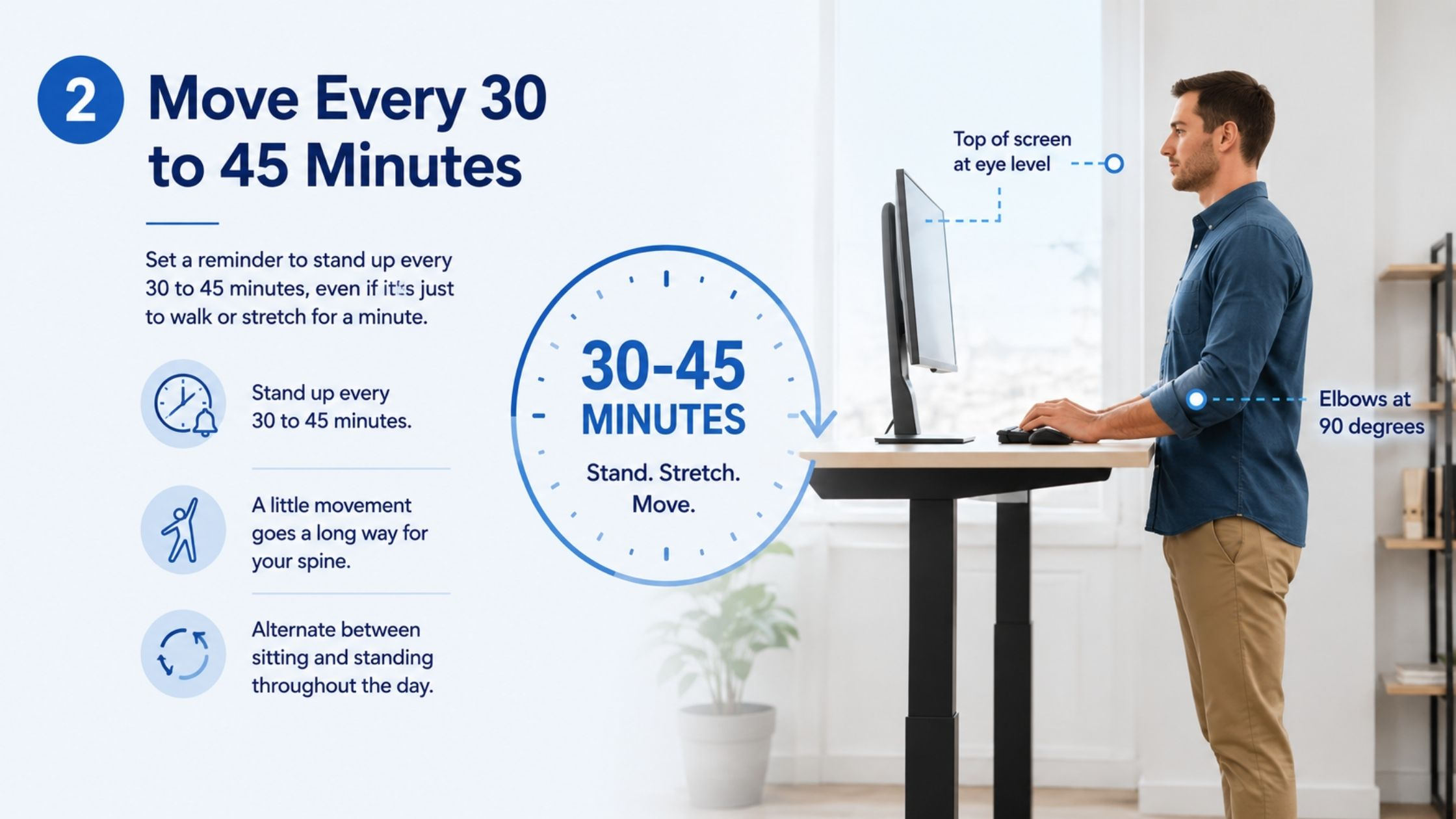
If you use a standing desk, the same rules still apply. Keep your elbows near 90 degrees and your screen at eye level, and don’t just trade one static position for another. Alternating between sitting and standing throughout the day does more for your spine than staying in either position all day long.
The “20-8-2 Rule” Every Office Worker Should Follow
Many ergonomists recommend a simple movement formula:
| Time | Activity |
|---|---|
| 20 Minutes | Sit with proper posture |
| 8 Minutes | Stand while working |
| 2 Minutes | Walk or stretch |
Repeating this throughout the day keeps joints lubricated, improves circulation, reduces spinal compression, and helps decrease muscle fatigue.
4. Pay Attention to How You Sleep
Your spine spends a third of the day in bed, and a bad sleep position can undo a well-set-up desk fast, especially if you have trouble sleeping because of neck pain.
A medium-firm mattress generally supports the lower back better than one that’s very soft or very firm. If you sleep on your side, although not as recommended, a pillow between your knees keeps your hips and spine aligned instead of twisted.
The best sleeping position is to sleep on your back with a small pillow under your knees to take pressure off the lower spine. Stomach sleeping is the position most likely to strain your neck and lower back at once, so it’s worth trying to break that habit if you can.
If you need an additional resource on which pillow to get for improving sleep, we’ve compiled a list below:
| Pillow Type | Why It Works |
| Cervical/Contour Pillows | Frequently recommended for neck pain due to built-in neck support and varied heights. Many studies report reduced pain and improved sleep when used with proper height adjustment. |
| Rubber/Latex Pillows | Meta-analytic evidence suggests that rubber and latex pillows can reduce neck pain along with waking symptoms. Patients reported better satisfaction in chronic neck pain cases. However, results on sleep quality are mixed. |
| Adjustable-Height Pillows | Some trials report that customizing pillow height to individual neck and shoulder anatomy yields better outcomes than fixed-height pillows, particularly for persistent neck stiffness. This is where pregnancy pillows come in, which we’ll talk more about later. |
5. Know When It’s More Than Posture
For a lot of people, the four tips above genuinely solve the problem. For others, they only help so much.
Sharp pain, shooting pain, or pain that radiates down one leg is a different pattern than general stiffness. It often points toward a nerve being affected, not just a postural strain. Numbness or tingling is another signal worth paying attention to, and so is pain that hasn’t budged after several weeks of consistent changes. According to Johns Hopkins Medicine, most back pain from a poor home setup resolves within about a month. Pain that lingers well past that point is worth a closer look.
If your pain sounds more like general stiffness, or a knot that flares up after a long day, general chiropractic care is often the right next step, and our colleagues at ASSC specialize in exactly that.
But radiating pain tells a different story. So does pain tied to a herniated or bulging disc, sciatica running down the leg, or a chronic ache that these ergonomic tips haven’t touched. Those patterns point toward a disc-related issue, which is exactly what non-surgical spinal decompression is built to address.
It’s worth reviewing your specific condition before assuming a new chair alone will fix it.
Chiropractic Treatments are Important If You Work from a Sitting Position
Top Reasons Regular Chiropractic Treatments are Important If You Work from a Sitting Position
For thousands of professionals working in Lincoln Park, Lakeview, River North, the Loop, Old Town, and Chicago’s North Side, the average workday now involves 7 to 10 hours of sitting. While remote work and hybrid schedules have improved flexibility, they’ve also created an entirely new category of musculoskeletal problems.
Many people unknowingly work from:
- Kitchen tables
- Coffee shop counters
- Dining room chairs
- Couches
- Standing desks that are improperly adjusted
Ergonomic Equipment for Improved Posture & Flexibility
| Equipment | Benefit |
|---|---|
| Adjustable Office Chair | Lumbar support and proper posture |
| Standing Desk | Reduces prolonged sitting |
| Monitor Arm | Keeps monitor at eye level |
| Ergonomic Keyboard | Reduces wrist strain |
| Vertical Mouse | Less forearm rotation |
| Footrest | Improves pelvic alignment |
| Lumbar Cushion | Supports the lower back |
| Laptop Stand | Prevents neck flexion |
| Anti-Fatigue Mat | Improves comfort while standing |
| Sit-Stand Desk Converter | Easy workstation transitions |
Lincoln Park Office Workers Are Sitting More Than Ever
These seemingly minor ergonomic mistakes place repeated stress on the muscles, ligaments, spinal discs, and joints. Over weeks and months, poor posture may contribute to:
- Chronic neck pain
- Lower back pain
- Shoulder tension
- Sciatica
- Herniated discs
- Headaches
- Tingling into the arms
- Hip tightness
- Reduced productivity
- Fatigue
The encouraging news is that many of these problems can be prevented—or significantly improved—with a few strategic changes to your workstation and daily routine.
Nutrition Also Plays a Role in Spinal Health
Healthy spinal discs depend on proper hydration and nutrition.
Consider prioritizing:
- Lean protein
- Omega-3 fatty acids
- Magnesium-rich foods
- Vitamin D
- Calcium
- Potassium
- Antioxidant-rich fruits and vegetables
Drinking sufficient water throughout the day also supports disc hydration and tissue health.
Ergonomics & Posture Alignment – FAQs
Can sitting too long cause sciatica?
Yes. Prolonged sitting can increase pressure on the lumbar discs and irritate the sciatic nerve, especially if a disc bulge or herniation is already present.
Is standing all day better than sitting?
Not necessarily. The healthiest approach is alternating between sitting, standing, and walking throughout the day.
How long does it take to improve posture?
Most people notice meaningful improvements within two to four weeks of consistently practicing ergonomic habits and mobility exercises.
Can chiropractic care help office workers?
Many office workers seek chiropractic care for posture-related discomfort, reduced spinal mobility, tension headaches, and repetitive strain associated with prolonged sitting. Treatment may include spinal adjustments, soft tissue therapy, corrective exercises, and ergonomic education tailored to workplace demands.
When should I see a chiropractor instead of just stretching?
If symptoms persist beyond several weeks despite ergonomic improvements, or if you experience radiating pain, numbness, weakness, or recurring episodes that interfere with work or daily activities, a comprehensive evaluation can help determine whether an underlying spinal or nerve condition requires targeted treatment.
Warning Signs Your Office Setup Is Hurting Your Spine
Ask yourself:
✔ Do you lean toward your monitor?
✔ Are your shoulders elevated all day?
✔ Does your lower back ache by 3 PM?
✔ Do you constantly shift positions?
✔ Does standing up feel stiff?
✔ Do you wake up sore after sleeping?
✔ Does your neck crack frequently?
✔ Do headaches start late in the workday?
If you answered “yes” to several of these questions, your workstation or the underlying mechanics of your spine, may need attention.
Why Lincoln Park Professionals Choose Advanced Spine & Sports Care
Advanced Spine & Sports Care has become a trusted destination for professionals throughout Lincoln Park, Lakeview, Lakeview East, Wrigleyville, North Center, Roscoe Village, Old Town, & Chicago’s North Side seeking conservative, evidence-informed care for spine and musculoskeletal conditions.
Our integrated approach combines advanced chiropractic care, corrective exercise, sports rehabilitation, and, when clinically appropriate, DRX9000® non-surgical spinal decompression to address the underlying cause of pain—not just temporary symptoms. Every treatment plan is personalized to help restore mobility, improve posture, enhance performance, and support long-term spinal health.
Whether you’re managing desk-related stiffness, recovering from repetitive strain, or seeking relief from disc-related conditions such as sciatica or herniated discs, our goal is to help you return to work, exercise, and everyday life with greater comfort and confidence.
Discover Lasting Pain Relief & Improved Mobility at Advanced Spine & Sport Care
If you’ve implemented these ergonomic changes and still wake up with stiffness or if your pain radiates down your shoulder, glutes, or legs. Ergonomics alone won’t solve the underlying structural issue.
A consultation at ASSC can help you understand whether your pain is something ergonomics can solve, or something that needs a closer look. There’s no pressure either way.
At Advanced Spine & Sports Care (conveniently located on the Lakeview/Lincoln Park border), we specialize in identifying the root cause of spinal pain:
-
General Back Stiffness & Postural Misalignment: Targeted chiropractic adjustments and active rehab.
-
Radiating Pain, Sciatica & Disc Bulges: Advanced non-surgical DRX9000 Therapy in Lincoln Park, we specialize in non-surgical spinal decompression for chronic, disc-related back pain, sciatica, and herniated discs that haven’t responded to the basics.
📍 2828 N Clark St, Chicago (Free Validated Garage Parking)
👉 Schedule Your Assessment HERE
Last Updated on September 11, 2026 by Chiropractor Dr. Jason Ingham DC, CCSP