


2026 Chicago Marathon: 55,000+ Runners. 26.2 Miles. One Ultimate Test.

By Advanced Spine & Sports Care | The Playbook for Endurance Athletes
On Sunday, October 11, 2026, Chicago will host the 48th running of the Bank of America Chicago Marathon, bringing one of the world’s most recognizable road races back to the streets of the city.
The scale is extraordinary.
More than 200,000 people applied for the opportunity to participate in the 2026 race, while more than 55,000 participants are expected to cross the finish line in Grant Park. The 2025 edition established a record with 54,383 finishers, underscoring just how competitive and physically demanding this event has become.
The Chicago Marathon also remains one of the world’s great spectator events. Approximately 1.7 million spectators are expected along the course as runners travel through 29 Chicago neighborhoods, supported by more than 12,000 race-day volunteers and 1,500+ medical personnel.
FILM BREAKDOWN: WHY YOUR RUNNING MECHANICS MIGHT COST YOU AT MILE 20

And then there is Mile 20…
For many marathoners, the final 10K is where months of preparation collide with fatigue, accumulated training stress, fueling decisions, pacing, and the body’s ability to maintain efficient movement under pressure.
That is why running mechanics deserve attention long before race morning.
Your objective is not to chase a mythical “perfect” running form. It is to understand how your individual movement patterns, mobility, strength, training load, recovery, and running mechanics interact as fatigue accumulates—and to address meaningful limitations before they become problems during the final miles.
At Advanced Spine & Sports Care in Chicago’s Lakeview neighborhood, our approach is centered on evaluating the individual runner rather than assuming that every athlete needs the same correction, exercise, or treatment.
Because the Chicago Marathon is not won—or completed successfully—by fitness alone.
It is a test of preparation, pacing, resilience, recovery, and the ability to keep your body moving efficiently when the race gets hard.
The Mile-20 Reality
The Chicago course is famously fast, but fast does not mean easy.
The final portion of the race requires runners to maintain coordination and output after more than 20 miles of repeated impact, metabolic stress, and muscular fatigue. By that point, even small changes in running mechanics can become more noticeable.
Your stride may shorten.
Your posture may change.
Your cadence or ground-contact pattern may shift.
Your hips may feel less mobile.
Your ability to stabilize your pelvis and trunk may decline.
The question is not whether your mechanics will remain absolutely identical from Mile 1 to Mile 26.2—they will not.
The question is whether your body has the capacity, strength, mobility, coordination, and recovery foundation to continue performing effectively as fatigue builds.
That is where an individualized movement and sports-care strategy can become valuable.
That final location is particularly relevant to the marathon experience.
At approximately Mile 20.3, runners are entering one of the most demanding portions of the race—when accumulated fatigue can make efficient movement increasingly difficult to maintain.
At the sharp end of the field, seconds matter.
For recreational runners, first-time marathoners, charity athletes, and Boston-qualifying hopefuls, the performance objective may be completely different—but the fundamental challenge remains the same:
How do you prepare your body to keep moving well when fatigue is no longer theoretical?
That is the real game film.
And that is where marathon preparation should begin long before you reach Columbus Drive.
FILM BREAKDOWN: WHY YOUR RUNNING MECHANICS MIGHT COST YOU AT MILE 20

The Chicago Marathon is more than 26.2 miles.
It is a prolonged test of endurance, pacing, strength, recovery, nutrition, mental resilience, and your body’s ability to maintain efficient movement when fatigue starts taking over.
Every October, runners from around the world converge on Chicago for the Bank of America Chicago Marathon. The course moves through the city’s iconic neighborhoods, surrounded by an extraordinary crowd and an atmosphere that can make even the final miles feel electric.
But experienced marathoners know something important:
The marathon you planned at Mile 1 can become a completely different race at Mile 20.
That is when accumulated fatigue begins to expose weaknesses that may have been invisible during shorter training runs.
- Your stride can change.
- Your posture can change.
- Your cadence can change.
- Your ability to stabilize your pelvis and trunk can change.
- The muscles that felt strong at Mile 8 may feel completely different at Mile 22.
And these changes can influence how efficiently you move.
That is why marathon preparation should not focus exclusively on mileage.
It should also consider movement quality, strength, mobility, recovery, training load, and your ability to maintain efficient mechanics under fatigue.
At Advanced Spine & Sports Care in Chicago, our sports chiropractic and rehabilitation approach is designed around that broader picture.
We don’t simply ask:
“Where does it hurt?”
We also ask:
“How are you moving?”
“What changes when you fatigue?”
“What physical limitations may be affecting your running?”
“What can you do during your training block to build greater capacity before race day?”
THE KINETIC CHAIN: WHY RUNNING MECHANICS MATTER
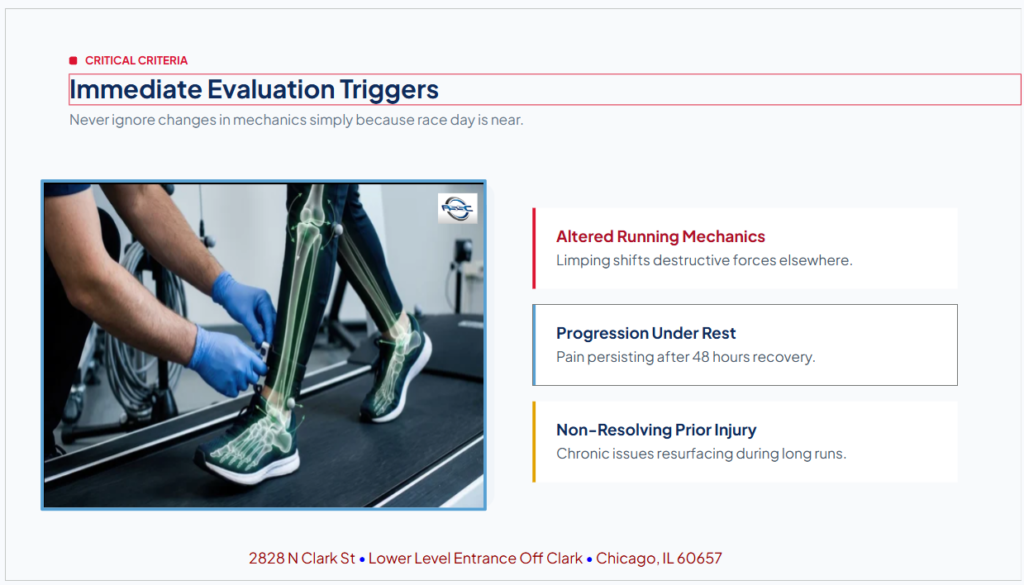
Running is a whole-body movement.
Although each foot strike occurs at the ground, the forces and movements involved in running are distributed through a coordinated system involving the foot, ankle, lower leg, knee, hip, pelvis, trunk, and upper body.
This interconnected relationship is commonly described as the kinetic chain.
The important takeaway is not that every running injury originates somewhere else.
It is that a change in one part of the movement system can influence how other areas move and absorb or produce force.
For a marathon runner, that matters because you repeat the running cycle thousands of times.
Small differences in movement may become more noticeable as fatigue accumulates.
A runner who maintains efficient mechanics throughout a training run may move differently once strength and coordination begin to decline late in a race.
That is why evaluating running mechanics should be about more than finding a single “bad” joint.
It is about understanding the complete movement strategy.
Fatigue is one of the most important variables in marathon biomechanics.
As fatigue increases, runners may experience changes in:
Stride characteristics
Cadence
Joint motion
Trunk position
Pelvic control
Muscle activation
Ground-contact patterns
Running economy
Perceived effort
Ability to maintain strength and stability
Not every runner responds to fatigue in exactly the same way.
That is why there is no single “perfect” running form that applies to every marathoner.
Instead, the objective is to identify whether a runner has meaningful limitations, asymmetries, pain, or changes in movement that could affect performance or increase physical stress.
FILM BREAKDOWN #1: THE HIP & PELVIS
The hip and pelvis play a major role in running.
The gluteal muscles contribute to hip extension and pelvic stability, while the surrounding musculature helps control the position of the pelvis and lower extremity during each stride.
Problems can arise when a runner lacks adequate hip mobility, strength, endurance, or control.
This does not mean that a particular pelvic position automatically causes injury.
Human movement is more complicated than that.
But if a runner has limited hip mobility or inadequate strength and control, compensatory movement may develop elsewhere.
That is why a comprehensive assessment may consider:
Hip range of motion
Hip strength
Single-leg stability
Pelvic control
Trunk control
Functional movement
Running-specific demands
The Marathon Takeaway
Your hips don’t need to be “perfect.”
They need to be capable of handling the demands you are placing on them.
A runner preparing for 26.2 miles should progressively develop the strength, mobility, and endurance necessary to maintain efficient movement as fatigue increases.
FILM BREAKDOWN #2: THE ANKLE & FOOT
Every running stride begins with interaction between the foot and the ground.
The foot and ankle complex must accommodate loading, help control movement, and contribute to propulsion.
Restricted ankle mobility can affect lower-extremity movement mechanics.
Foot strength and control can also influence how a runner manages repetitive loading.
This does not mean that one specific foot position causes every running injury.
Instead, clinicians should look at the entire context.
A running assessment may consider:
Ankle dorsiflexion
Foot mobility
Calf strength
Single-leg balance
Lower-extremity control
Running volume
Footwear
Training surface
Previous injury
Why It Matters at Mile 20
A limitation that is barely noticeable during a five-mile run may become more significant during a long training run or marathon.
The question is not whether your feet are “aligned perfectly.”
The question is whether your feet and ankles have sufficient capacity to tolerate the demands of your training.
FILM BREAKDOWN #3: THE KNEE
Runner’s knee is not simply a “knee problem.”
But it is also inaccurate to say that every knee problem is actually caused by the back.
The knee exists within a larger movement system.
Hip strength, lower-extremity mechanics, training load, running volume, previous injury, muscle capacity, and individual anatomy can all influence how a runner experiences knee symptoms.
That is why a comprehensive evaluation should examine more than the painful location.
For a runner with knee pain, a clinician may evaluate:
Hip strength
Knee motion
Ankle mobility
Single-leg control
Running mechanics
Training load
Recent changes in mileage
Previous injuries
Recovery
The objective is to understand the entire clinical picture.
FILM BREAKDOWN #4: THE TRUNK & RUNNING POSTURE
Your upper body is part of your running mechanics.
The trunk must remain sufficiently controlled while the arms, pelvis, and lower extremities coordinate movement.
As fatigue increases, some runners may develop greater trunk movement or changes in posture.
However, there is no universal “perfect” running posture.
Trying to force every athlete into the exact same position can be counterproductive.
Instead, the focus should be on whether a runner can maintain comfortable, efficient movement appropriate to their individual anatomy, pace, experience, and physical demands.
BREAKDOWN #5: TRAINING LOAD MAY MATTER MORE THAN “ALIGNMENT”
One of the most important factors in marathon preparation is training load.
Running performance depends on progressive adaptation.
If mileage, intensity, hills, speed work, or long-run volume increases too rapidly, the body may not have sufficient time to adapt.
Training-related problems can therefore develop even in runners with excellent movement mechanics.
A comprehensive marathon strategy should consider:
Weekly mileage
Long-run progression
Speed-work volume
Hill training
Recovery days
Strength training
Sleep
Nutrition
Previous injuries
Race schedule
Individual training history
Good biomechanics cannot compensate for an inappropriate training load.
And good training cannot always overcome a significant physical limitation.
The strongest approach considers both.
THE 2026 MARATHON PERFORMANCE PLAYBOOK
At Advanced Spine & Sports Care, sports chiropractic and rehabilitation can be incorporated into a runner’s broader training strategy when clinically appropriate.
| TRAINING PHASE | POTENTIAL FOCUS |
|---|---|
| Early Training | Baseline movement and musculoskeletal evaluation |
| Mileage Build | Mobility, strength, recovery and load-management support |
| Peak Training | Functional assessment and management of training-related limitations |
| Taper | Maintain mobility and avoid introducing unnecessary treatment or training stress |
| Race Week | Recovery, sleep, hydration, nutrition and established routine |
| Post-Race | Recovery assessment and gradual return to normal training |
The specific approach should always be individualized.
1. SPORTS CHIROPRACTIC & JOINT MOBILITY
Spinal manipulation and joint mobilization can be useful conservative treatment tools for appropriately selected patients with certain musculoskeletal conditions.
For runners, treatment may be directed toward areas where restricted mobility, discomfort, or musculoskeletal dysfunction is clinically relevant.
The goal is not to repeatedly “realign” the runner.
It is to address appropriate musculoskeletal findings and support the runner’s ability to move comfortably and participate in their training program.
When manual treatment is used, it should complement—not replace—strength, conditioning, recovery, and progressive training.
2. ACTIVE REHABILITATION FOR THE ENDURANCE RUNNER
Manual treatment is only one component of a comprehensive strategy.
Runners also need physical capacity.
That may include developing:
Hip strength
Calf strength
Core and trunk endurance
Single-leg stability
Balance
Mobility
Coordination
Muscular endurance
Running-specific tolerance
A runner should not simply feel better.
The objective is to help build the capacity required to handle the demands that caused the problem in the first place.
3. SOFT-TISSUE & MYOFASCIAL CARE
Soft-tissue treatment may be incorporated into a broader rehabilitation strategy when appropriate.
Depending on the individual, treatment may address areas of muscular tension, localized soft-tissue sensitivity, or mobility limitations.
However, soft-tissue treatment should not be viewed as a substitute for progressive exercise and appropriate training modification.
A marathoner’s long-term solution is not simply to repeatedly “loosen” the same tissue.
The goal is to understand why the tissue is being stressed and develop greater physical capacity where appropriate.
4. DRX9000® SPINAL DECOMPRESSION
Some runners experience persistent low back symptoms or leg symptoms associated with diagnosed spinal conditions.
For appropriately selected patients, Advanced Spine & Sports Care may offer DRX9000® computerized spinal decompression as one component of conservative care.
It is important to understand what spinal decompression is—and what it is not.
It should not be presented as a universal treatment for marathon-related soreness or as a guaranteed method of repairing a damaged disc.
Candidacy should be determined through a clinical evaluation that considers symptoms, history, examination findings, previous treatment, and other relevant factors.
For a runner with persistent or radiating symptoms, an appropriate evaluation is more important than simply continuing to train through pain.
5. RUNNING MECHANICS & MOVEMENT ASSESSMENT
Running form is highly individual.
There is no single stride pattern that every marathoner needs to achieve.
Instead, a movement assessment can help identify meaningful limitations or changes that may be relevant to the runner’s symptoms or performance goals.
Depending on the runner, evaluation may consider:
Stride characteristics
Cadence
Trunk position
Pelvic control
Hip mobility
Knee mechanics
Ankle mobility
Foot function
Single-leg stability
Strength
Balance
Training history
The goal is not to manufacture a “perfect” running form.
It is to determine whether there are specific, modifiable factors worth addressing.
THE MILE-20 PROBLEM: WHEN FATIGUE EXPOSES WEAKNESSES
Why does a runner sometimes feel fantastic at Mile 10 and completely different at Mile 20?
Because endurance performance depends on maintaining physical capacity under fatigue.
As the race progresses, the challenge becomes increasingly about maintaining:
Strength + Coordination + Stability + Energy + Pacing + Mental Resilience
- A runner who lacks sufficient strength endurance may struggle to maintain mechanics.
- A runner who increased mileage too quickly may develop symptoms.
- A runner who enters race day under-recovered may struggle regardless of how good their movement looks.
- A runner with an unresolved injury may experience escalating symptoms.
The marathon does not expose only one weakness.It exposes the weakest links in the entire preparation process.
THE CHICAGO MARATHON RACE-WEEK STRATEGY
Race week is not the time to reinvent your running mechanics.
It is not the time to introduce an aggressive new strength program.
And it is usually not the time to experiment with unfamiliar treatments.
Your goal is to arrive at the starting line healthy, rested, fueled, and confident.
7–10 Days Before the Race
Focus on maintaining your established routine.
A clinical assessment may be appropriate if you have an existing musculoskeletal concern, but avoid introducing unnecessary treatment that could produce unfamiliar soreness or irritation.
Continue your established taper, recovery, nutrition, hydration, and sleep strategy.
The Day Before the Race
Prioritize:
Sleep
Hydration
Familiar nutrition
Light movement
Race preparation
Appropriate carbohydrate intake according to your established plan
Avoid experimenting with unfamiliar interventions.
Race Morning
Your goal is simple:
Execute the plan you trained for.
Pacing, fueling, hydration, and mental strategy are just as important as biomechanics.
Do not suddenly try to change your stride because something you read online told you that your running form is “wrong.”
AFTER 26.2 MILES: RECOVERY COMES FIRST
The marathon creates substantial physiological stress.
Immediately after finishing, the priority should be recovery.
That means appropriate:
Hydration
Nutrition
Rest
Gentle movement
Sleep
Monitoring of symptoms
Normal post-race soreness is different from significant or worsening pain.
If you develop severe pain, substantial swelling, inability to bear weight, neurological symptoms, chest pain, difficulty breathing, or other concerning symptoms, seek appropriate medical evaluation.
For runners experiencing persistent musculoskeletal symptoms after the race, a post-race assessment can help determine whether additional rehabilitation or treatment is appropriate.
DON’T CONFUSE PAIN TOLERANCE WITH PERFORMANCE
One of the most dangerous ideas in endurance sports is:
“If I can tolerate it, I should keep running.”
Pain is information.
It does not automatically mean serious injury.
But persistent, worsening, or functionally limiting pain should not simply be ignored because a race is approaching.
A marathon goal is important.
Your long-term ability to run is more important.
If something doesn’t feel right during training, an appropriate evaluation can help determine whether the problem is something that can be managed while modifying activity—or whether continued training could make the situation worse.
YOUR CHICAGO MARATHON GAME PLAN
A successful marathon preparation strategy is bigger than chiropractic care.
It includes:
1. Progressive Training
Build mileage and intensity according to your experience and training plan.
2. Strength Training
Develop the strength and endurance necessary to tolerate running volume.
3. Mobility
Maintain the range of motion required for your individual movement demands.
4. Recovery
Prioritize sleep, nutrition, hydration, and appropriate recovery days.
5. Injury Management
Don’t ignore persistent symptoms simply because race day is approaching.
6. Movement Assessment
When appropriate, identify meaningful mobility, strength, or movement limitations.
7. Race-Day Execution
Trust the pacing, fueling, hydration, and preparation strategy you practiced during training.
FROM LAKEVIEW TO THE FINISH LINE
Whether you are chasing a Boston-qualifying time, running for charity, attempting your first marathon, returning after an injury, or simply challenging yourself to complete 26.2 miles, preparation matters.
The goal is not to make every runner move identically.
The goal is to help each runner understand their body, build appropriate physical capacity, manage training demands, and address meaningful musculoskeletal problems before they become bigger obstacles.
At Advanced Spine & Sports Care in Chicago’s Lakeview neighborhood, sports chiropractic and rehabilitation-oriented care can be part of that larger strategy.
We work with active individuals who want to keep moving—whether that means running a marathon, returning to training, competing in sport, or simply staying active without being limited by recurring musculoskeletal problems.
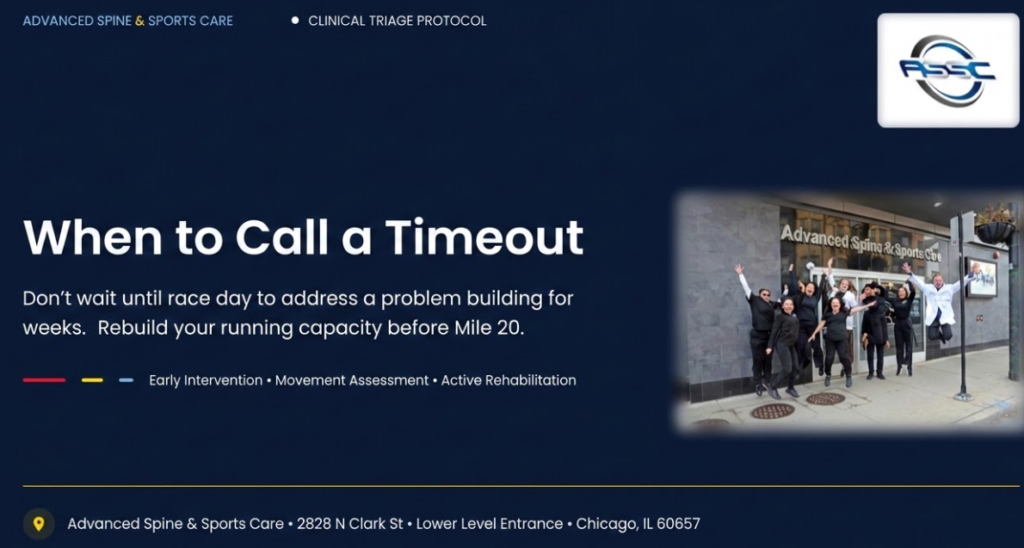
Don’t wait until race day to address a problem that has been building for weeks.
Consider getting evaluated if you experience:
Persistent back pain
Recurring knee pain
Hip pain
Achilles or calf symptoms
Foot or plantar pain
Shin pain
Recurrent hamstring problems
Persistent neck or upper-back discomfort
Radiating pain
Symptoms that progressively worsen with training
Pain that changes your running mechanics
An injury that has not returned to normal function
The earlier an appropriate problem is identified, the more options may be available for modifying training and supporting recovery.
BEFORE…THE FINAL WHISTLE
The Chicago Marathon rewards preparation.
Not perfection. You don’t need the “perfect” stride.
You need a body capable of handling the demands you’ve asked it to handle.
Build the mileage gradually.
Build the strength.
Respect recovery.
Pay attention to persistent symptoms.
Understand your movement.
And when something isn’t right, don’t wait until Mile 20 to call a timeout.
Your best marathon starts long before race morning.
READY TO REBUILD YOUR RUNNING GAME?
Your marathon is 26.2 miles.
Your preparation is much longer.
Don’t wait for Mile 20 to discover that your body wasn’t ready for the demands of race day.
Whether you’re beginning a new training block, increasing mileage, dealing with a recurring running injury, or preparing for post-marathon recovery, Advanced Spine & Sports Care will evaluate your musculoskeletal needs and help determine whether chiropractic care, rehabilitation, or another appropriate strategy fits your situation.
Advanced Spine & Sports Care
Chiropractic Wellness • Sports Medicine • Rehabilitation
Lakeview / Lincoln Park – Chicago
2828 N Clark St
Lower Level Entrance Off of Clark
Chicago, IL 60657
Phone: (773) 868-0347

Last Updated on October 9, 2026 by Chiropractor Dr. Jason Ingham DC, CCSP