

What is the SI Joint? (Anatomy & Biomechanics)
Think of your spine as a high-performance chassis. The sacroiliac joint serves as the vital structural hinge connecting your sacrum (the triangular base of your spine) to the ilium (the wide hip bones of your pelvis).
-
The Primary Shock Absorber: Every time your foot hits the concrete on Clark Street or you plant during a sprint, the SI joint absorbs and transfers kinetic energy between your upper body and lower extremities.
-
Engineered for Stability, Not Mobility: Unlike the wide range of motion in your shoulder or hip socket, the SI joint is locked down by a thick web of interosseous and sacroiliac ligaments. Normal biomechanical motion is minimal, just 2 to 4 millimeters of glide and less than 4 degrees of rotation.
When those microscopic mechanics drift out of alignment, the entire kinetic chain suffers.
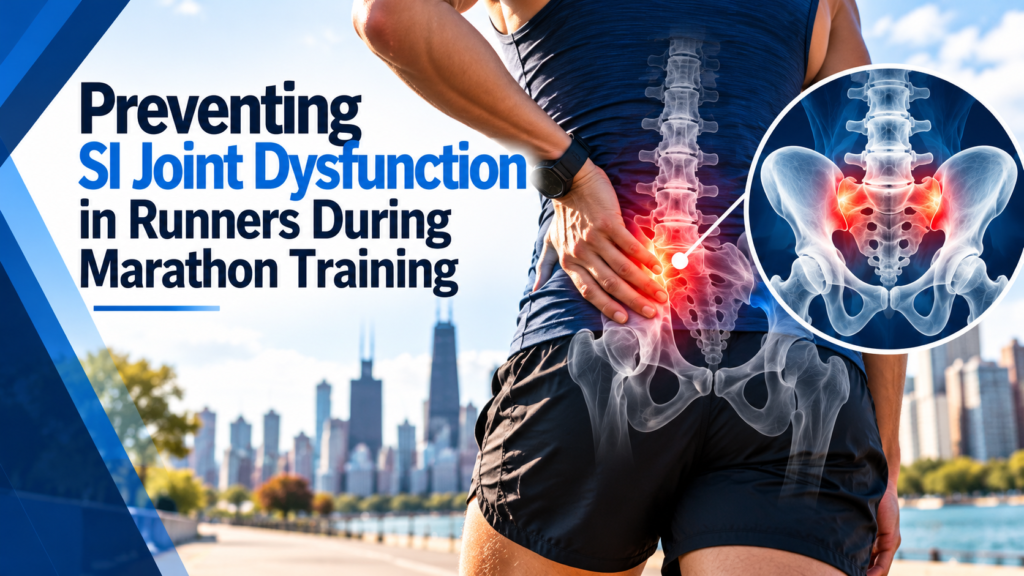
SI joint dysfunction in runners is pain from the sacroiliac joint, where the base of your spine meets your pelvis. It shows up on one side, just below the belt line, usually during or after a long run.
Most of what you’ll read blames a pelvis that has slipped out of place. However, that’s not always accurate.
Whether you’re training for the Chicago Marathon this coming October 11 or going through a post-recovery phase, the best-supported ways to prevent SI Joint Dysfunction are managing how fast you add mileage and building hip and glute strength.
Below, you’ll learn why and how SI Joint Dysfunction shows up, ways to manage it, and whether it’s safe to run with.
What SI Joint Dysfunction Feels Like in Runners and What (SI-JD) Often Gets Mistaken For …
Runners describe a deep ache on one side, low and just off-center.
You can usually point to it with one finger, near the dimple above your glute. You’ll notice it when you stand up after sitting, climb stairs, or load that leg alone. Lying on that side at night is often worse than running on it.
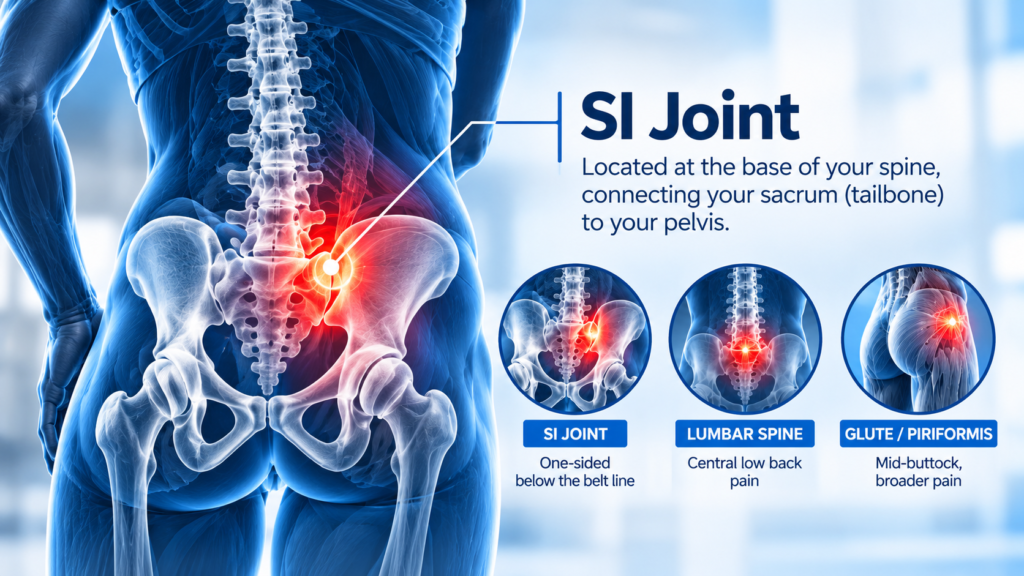
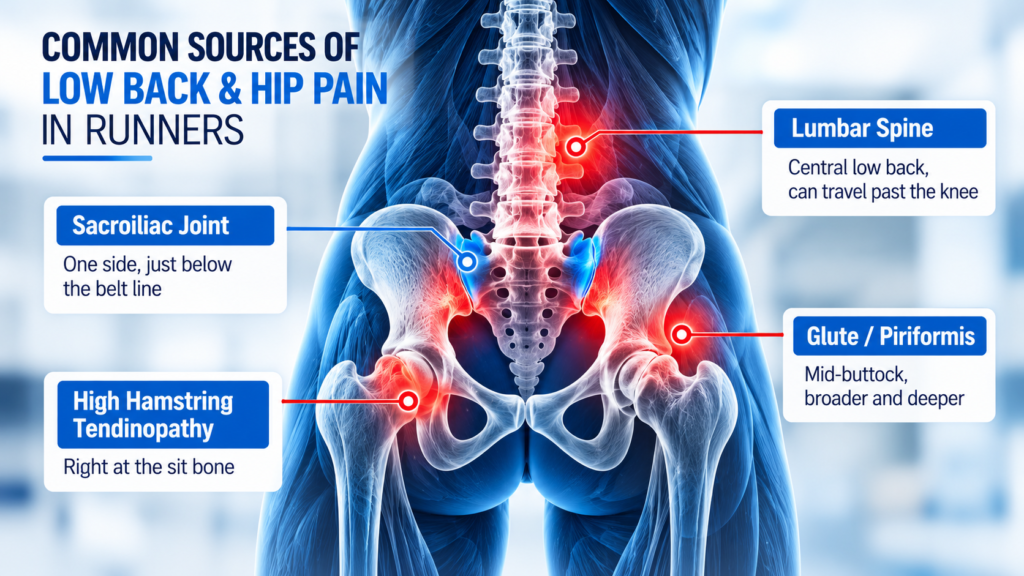
Pain you can cover with a fingertip points toward the sacroiliac joint (the pair of joints connecting your sacrum to the ilium). Pain you have to sweep a whole hand across usually points elsewhere.
| Source | Where it hurts | What triggers it | Key Takeaway |
|---|---|---|---|
| Sacroiliac joint | One side, just below the belt line | Standing up from sitting, stairs, single-leg loading | Rarely crosses the midline |
| Lumbar spine or disc referral | Central low back, can travel past the knee | Bending forward, long sitting, coughing | Symptoms shift toward the spine as they improve |
| Deep glute or piriformis | Mid-buttock, broader and deeper | Hard seats, hill repeats | Needs a whole hand to cover |
| High hamstring tendinopathy | Right at the sit bone | Faster paces, hard edges | Sharpens as pace increases |
The sacroiliac joint dysfunction symptoms runners report overlap with all three, which is why self-diagnosis from a symptom list usually goes sideways. If your pain travels down the back of the leg, our page on hip, leg, and nerve-related pain covers that pattern.

Can You Continue Long Distance Running With SI Joint Pain?
Often yes, with modifications, and only within limits.
Running is usually tolerable if the pain stays minimal, doesn’t get worse as miles add up, and settles within about a day. Pain that worsens mile to mile, changes your stride, or sends symptoms down your leg is a sign to have it checked.
If you notice any of these signs, it’s advisable to hit pause on running:
- Weakness in the leg
- Groin pain, or pain that wakes you at night
- Numbness or tingling traveling below the knee
- A visible limp, or a stride that has obviously changed
- Pain that hasn’t settled 24 hours after the run that caused it
Why It Shows Up During Marathon Training
The two strongest predictors aren’t in your pelvis.
They’re your previous injuries and how fast you’ve been adding mileage. There are several studies that prove this.
The SI Joint: The Hidden Core Glitch Trashing Your Lower Back Performance
Whether you’re logging miles along the Lakefront Trail, grinding through heavy deadlifts in Lincoln Park, or sitting through back-to-back Zoom calls in East Lakeview, lower back pain has a way of derailing your momentum.
When low back discomfort strikes, standard diagnosis often shifts immediately to a herniated disc or a tight hamstring. However, up to 30% of chronic lower back pain stems from a powerful pelvic shock absorber: the Sacroiliac (SI) joint.
3 Most Common Causes of SI Joint Breakdown
When the micro-motion of the SI joint is disrupted, pain signaling spikes. The condition usually falls under one of three main categories:
1. SI Joint Dysfunction (Hypermobility vs. Hypomobility)
-
Too Loose (Hypermobility): When surrounding ligaments become lax—frequently caused by pregnancy (due to the hormone relaxin), repetitive rotational strain, or traumatic impact—the joint shears out of place, firing off acute inflammatory responses.
-
Too Stiff (Hypomobility): Chronic spinal imbalances, pelvic tilt, or repetitive strain cause the joint to lock up, forcing adjacent segments like the L5-S1 lumbar disc to overcompensate.
2. Sacroiliitis (Direct Joint Inflammation)
Sacroiliitis is active chemical inflammation inside the joint space. Common triggers include:
-
Direct physical trauma (a heavy fall, a car accident along Lake Shore Drive, or sports injuries).
-
Degenerative osteoarthritis from years of high-impact wear and tear.
-
Underlying inflammatory conditions such as ankylosing spondylitis.
3. Post-Spinal Fusion Transfer Stress
For individuals who have undergone lumbar spinal fusion, up to 40% eventually develop SI joint pain. Locking rigid spinal segments transfers heavy biomechanical load downward directly into the pelvic foundation.
At Advanced Spine & Sports Care (located right on North Clark Street bridging Lakeview & Lincoln Park), Dr. Jason Ingham, Dr. Erin Schey, Dr. Luiz Neto and our sports medicine team diagnose and resolve SI joint dysfunction at the source, getting active runners back to peak operational capacity without unnecessary downtime.
Key Symptoms: How to Spot SI Joint Dysfunction
Because SI joint pain mimics sciatica, hip impingement, and lumbar disc herniations, it is frequently misdiagnosed. Look out for these telltale signs:
-
Unilateral Lower Back Pain: A persistent, deep ache concentrated on one side of your lower back, upper buttock, or groin.
-
Referred Thigh Pain: Dull, aching pain radiating down the back or side of the upper thigh (crucially, SI joint pain rarely travels below the knee).
-
Positional Flare-Ups: Pain that spikes during single-leg loading—such as climbing stairs, getting out of a car, rolling over in bed, or standing after prolonged sitting.
How to Prevent SI Joint Dysfunction in Runners During Chicago Marathon Training
In one study of recreational runners, an iliac crest height difference over 5mm showed no association with injury (p = 0.88). Instead, past running injury, and racing more than once a year contributed the most. A companion case series found correcting differences under 9mm didn’t improve pain or performance either.
Load tells a similar story. A one-year study of 874 novice runners found more distance-related injuries among those who raised weekly distance by more than 30% across two weeks. Those injuries included gluteus medius strain and greater trochanteric bursitis, both sitting right beside the SI joint.
4 Tips on How to Prevent SI Joint Dysfunction While Running
A systematic review of nine studies found manual therapy and exercise both reduced pain and disability in sacroiliac joint dysfunction.
Laslett’s review makes the stronger case for specific lumbopelvic stabilization training, citing trials where targeted work roughly halved disability at one year. Where they agree is exercise, which is why a good plan for runners leans there first.
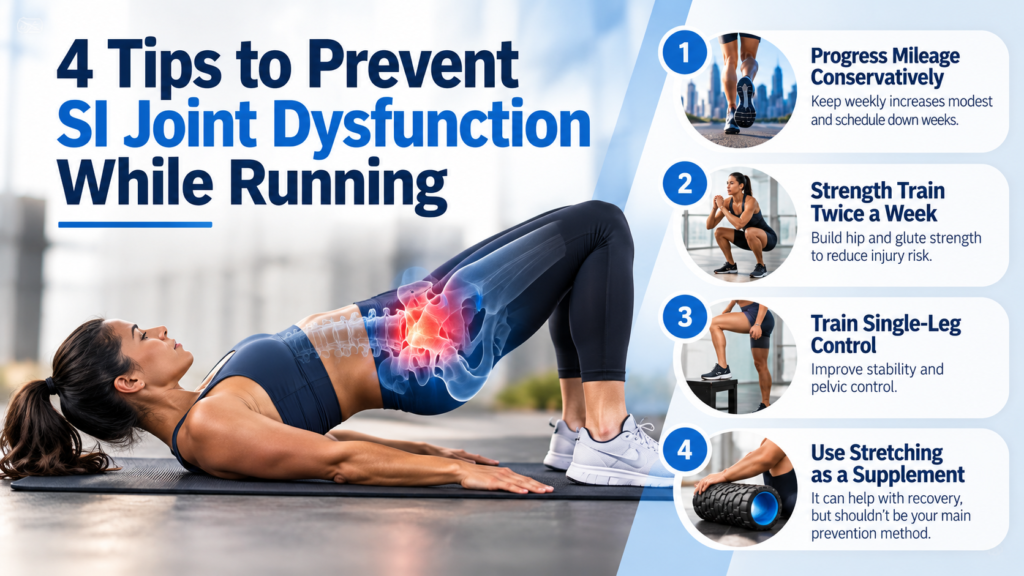
The four tips as mentioned below have proven evidence behind them. Take each one as a guide, and observe how you feel as you apply them while training:
- Progress mileage conservatively, and schedule down weeks. Keep weekly jumps modest. Build a reduced week into every third or fourth. The familiar 10% rule is a convention rather than a tested threshold, but it points the right way.
- Strength train twice a week. A meta-analysis of 25 trials and 26,610 participants found strength training cut overuse injuries roughly in half, and sports injuries overall to under a third. A follow-up review found the effect was dose-dependent.
- Train single-leg control, not just straight-line strength. Female runners with SI joint pain showed more pelvic drop at midstance than matched controls. The gap was 7.8 degrees versus 5.2, alongside a stiffer landing.
- Treat stretching and foam rolling as a supplement, not insurance. In that same meta-analysis, stretching showed no injury-prevention benefit at all. It may still feel good after a long run. It just shouldn’t be the main prevention method for SI Joint Dysfunction.
If you want a warm-up built around control rather than static holds, ASSC’s dynamic warm-up routines for runners are organized around exactly that.
Related reading: low back pain and sports injury care for athletes.
Precision Diagnosis & Targeted Care at Advanced Spine & Sports Care
Standard X-rays and MRIs often fail to capture microscopic SI joint dysfunction. That is why our Lincoln Park and Lakeview sports chiropractors use dynamic clinical diagnostics:
-
Provocative Physical Exams: We utilize specialized orthopedic maneuvers (like the FABER, Gaenslen’s, and Compression tests) to stress the SI joint controlledly and reproduce your exact pain profile.
-
Precision Realignment & Decompression: Utilizing customized chiropractic adjustments, Active Release Technique (ART), and non-surgical spinal decompression, we restore natural joint mechanics and take mechanical pressure off irritated nerves.
-
Pelvic Core Stabilization: Pain relief is only half the battle. Our sports physical therapy programs focus on strengthening the deep core stabilizers (gluteus medius, transverse abdominis, and piriformis) to lock the pelvis into long-term alignment.
SI Joint Dysfunction in Chicago Runners: Most Common Question, Answered
Will SI joint dysfunction ever go away?
Sacroiliac joint pain often settles, but the timeline is longer than runners expect: months rather than weeks. It also tends to be non-linear, with good stretches followed by a flare after a long run. That pattern is normal, so don’t be alarmed.
Should I stretch my SI joint?
You can’t meaningfully stretch the sacroiliac joint itself. With under 4 degrees of available motion, there’s almost nothing to lengthen. Stretching the muscles around it may ease symptoms, but the evidence doesn’t support stretching as prevention.
Do SI joint belts help runners?
Some runners find a pelvic belt more comfortable during a flare, and it’s low-risk to try. Treat it as a short-term aid while you address load and strength. Not as the fix.
Is running bad for SI joint dysfunction?
Not inherently. Running is a repetitive single-leg load, which is why it exposes an irritable joint. But complete rest usually isn’t the answer either. Reduced, modified running plus strength work is the more common and effective approach.
When to Book an Appointment at ASSC, Award-Winning Chicago Sports Chiropractic Team
Two weeks without change is a reasonable line to draw.
If the pain hasn’t shifted after two weeks of reduced mileage and consistent strength work, an evaluation is worth the appointment. Go sooner if symptoms travel down your leg or your stride has visibly changed.
What this looks like in practice usually involves a look at your medical or injury history first, then screening of the lumbar spine and hip, followed by a provocation cluster and your training routine weeks before the symptoms started.
At Advanced Spine & Sports Care, Dr. Jason Ingham, DC, holds a Certified Chiropractic Sports Physician (CCSP) credential (a postgraduate qualification specific to treating athletes).
Get Treatment for SI Joint Dysfunction At Advanced Spine & Sports Care
SI joint dysfunction in runners is solvable for most Chicago marathoners, and is best treated with load management and strength work rather than a quick fix.
If you’d rather know what you’re dealing with than guess at it, you can reach us at (773) 868-0347 or book an appointment directly on our website.
Take Back Your Running Performance in Lakeview & Lincoln Park, Chicago!
You don’t have to train through persistent lower back or pelvic pain. At Advanced Spine & Sports Care, our board-certified team delivers comprehensive, hands-on sports rehabilitation tailored to active North Side lifestyles.
-
Location: 2828 N Clark St (Lower Level), Chicago, IL 60657 (Convenient to Lakeview, Lincoln Park & East Lakeview)
-
Perks: Free validated garage parking next to our clinic & 150+ in-network insurance plans accepted
-
Call Today: (773) 868-0347
Last Updated on October 9, 2026 by Chiropractor Dr. Jason Ingham DC, CCSP