
You rolled your ankle on a trail run. Your shoulder has been aching for weeks after swim practice. Something went wrong in your lower back mid-deadlift and it hasn’t felt right since. Now you’re trying to figure out who to call – a chiropractor, an orthopedic doctor, your primary care physician, or someone else entirely.
The honest answer is that it depends on the injury.
Some sports injuries respond well to chiropractic care. Others require orthopedic evaluation. Some need both, at different points in recovery. This article lays out the distinctions clearly, not to steer you toward one option, but to help you make an informed decision about your own situation.
Sports Injuries That Benefit from Chiropractic Treatments
Chiropractic care is best suited to soft tissue and musculoskeletal injuries where the underlying mechanism, such as joint restriction, muscle imbalance, or biomechanical dysfunction, is driving the problem.
It’s not the right first call for every sports injury, and a clinician trained in sports care should be the first to tell you that. Below, we’ll look at several types of injuries that may or may not be suited to chiropractic care:
Sprains/Strains
For sprains and strains, ankle rolls, low back strains from lifting, wrist injuries from a fall, the injury involves soft tissue damage that benefits from hands-on treatment aimed at restoring range of motion and reducing scar tissue formation.
These are conditions where conservative care is typically the appropriate first step, and where chiropractic has a reasonable evidence base.
A 2015 PMC systematic review of chiropractic care across multiple conditions found it to be effective for the prevention and treatment of lower limb muscle strain and lateral epicondylitis (tennis elbow) compared to conventional treatments, although the authors noted the need for more comprehensive research.
Shoulder Injuries
Shoulder injuries such as rotator cuff irritation, shoulder impingement, and AC joint sprains tend to develop gradually through overuse in swimmers, baseball players, and overhead athletes.
Caught early, they respond well to joint mobilization and soft tissue work. Left alone, they frequently progress to structural problems.
The choice between chiropractic care and physical therapy as the initial approach for a shoulder injury hinges on the particular symptoms displayed, underscoring the importance of a precise diagnosis prior to commencing treatment.
Overuse Injury
Overuse injuries are a category where sports chiropractic offers a distinctive approach, though not an exclusive one.
Runner’s knee, IT band syndrome, Achilles tendinitis, and plantar fasciitis can be addressed by both chiropractors and orthopedic physicians. The determining factors are the specific tissues involved, severity, and the patient’s history.
Where sports chiropractic adds something different is in evaluating the full kinetic chain rather than treating only the symptomatic site. A runner’s IT band problem, for instance, often originates in hip abductor weakness or a gait asymmetry, not in the knee itself. Addressing the source rather than just the symptom is where a biomechanically-focused evaluation changes outcomes.
Lower Back Pain
Chiropractic care shines when it comes to musculoskeletal conditions. Lower back pain from sport is one of the most common presentations in sports chiropractic, and also one of the most clinically well-supported.
The American College of Physicians recommends spinal manipulation as a first-line, non-drug therapy for acute and subacute low back pain; a guideline that reflects a substantial body of research.
That does not mean chiropractic resolves every low back presentation, but for musculoskeletal lower back pain without neurological involvement, it is a well-evidenced starting point.
How is Sports Chiropractic Different From Other Treatments
What Sets a Sports Chiropractor Apart
General chiropractic education covers spinal manipulation, musculoskeletal assessment, and soft tissue care.
A sports-credentialed chiropractor adds a layer of sport-specific training on top of that, but it is worth discussing what that means for your sports injury.
The Certified Chiropractic Sports Physician (CCSP) credential, issued by the American Chiropractic Board of Sports Physicians (ACBSP), requires a minimum of 100 hours of accredited postgraduate education in sports medicine, biomechanics, and athletic injury care, followed by a written board examination.
That is a meaningful additional qualification since it ensures the clinician has formal, tested knowledge of sports injury patterns, athletic performance demands, and field-side emergency protocols. It is not equivalent to an orthopedic surgery residency or a sports medicine fellowship, and it should not be presented as such.
What it does represent is a practitioner who has specifically trained to evaluate and treat athletes, not just general musculoskeletal patients.
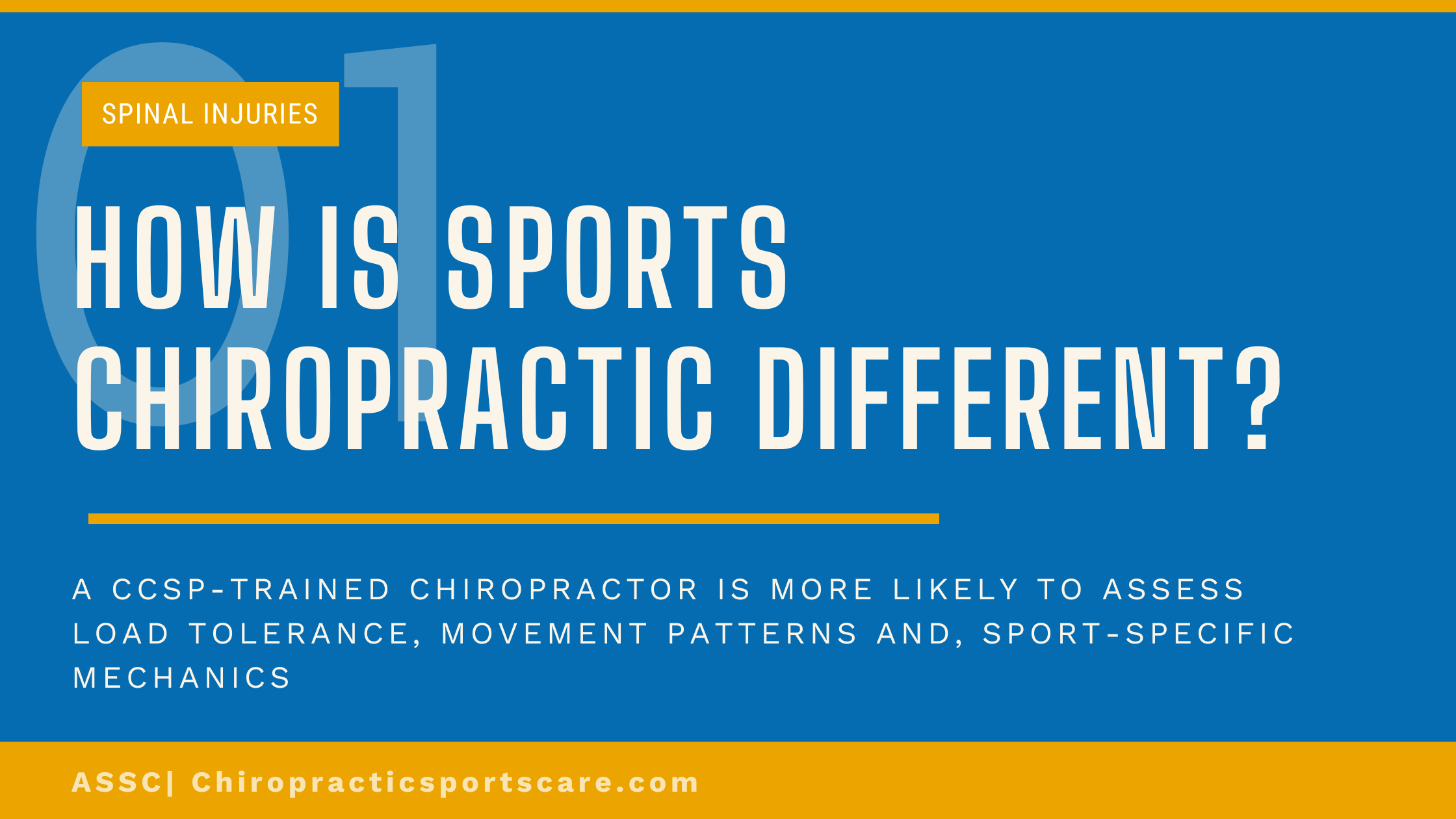
In clinical practice, that distinction tends to show up in the evaluation. A CCSP-trained chiropractor is more likely to assess:
- Load tolerance
- Movement patterns and;
- Sport-specific mechanics
Rather than simply examining the painful site in isolation. The question isn’t only “where does it hurt”, it’s “what is the movement demand of your sport and where is your body compensating?” That framing changes both the diagnosis and the treatment plan.
Dr. Jason Ingham, DC, CCSP, founded Advanced Spine & Sports Care in Lakeview in 2000. He holds the CCSP credential and has been recognized in America’s Top Chiropractors and Chicago Magazine’s Top Ten Chiropractors.
Dr. Erin Schey brings additional training in Chiropractic Biophysics and kinesiology. Between the two, the practice has experience across a wide range of athletic presentations, from competitive runners and cyclists to recreational gym athletes and weekend sport players.
It is also worth stating plainly what chiropractic does not do: chiropractors cannot prescribe medication, order surgery, or manage injuries that require imaging-confirmed structural repair. For conditions in that category, orthopedic evaluation is appropriate, and a good sports chiropractor will tell you so and refer accordingly.
When You Need an Orthopedic Specialist Instead
Some injuries fall outside the scope of chiropractic care, and knowing the difference protects you from spending time on the wrong treatment path.
- Suspect a fracture? Go get imaging first. A sharp, localized pain after a collision that makes normal movement feel impossible needs to be ruled out before any hands-on treatment happens.
- Complete ligament tears, including ACL ruptures, typically need orthopedic evaluation and may require surgical repair.
- The same applies to full-thickness rotator cuff tears, significant meniscus damage, and dislocations.
If you’re experiencing neurological symptoms from a sports injury, such as spreading numbness or tingling in an arm or leg, progressive weakness, or any change in bladder or bowel function, that warrants a medical evaluation, not an adjustment.
These are red flags that point beyond the musculoskeletal system. Chiropractic care is not always equipped to address them, and attempting treatment before ruling out something more serious can cause harm. When those symptoms are present, the right move is urgent medical care.
Chiropractic and orthopedic care aren’t competing approaches.
Many patients at Advanced Spine & Sports Care have worked with orthopedic physicians before arriving. Some are referred back mid-care when a clinical finding warrants it. The goal is the right treatment for the injury, not the treatment that happens to be available in the room.
When the Injury Involves a Lumbar Disc
Disc injuries from sports fall in their own category.
A herniated or bulging disc aggravated by heavy lifting, a compression injury from a fall, or a disc condition that’s worsened with repetitive athletic load often responds well to chiropractic care, but not always fully. Standard adjustments address joint mechanics and muscle tension around the disc. They don’t directly decompress the disc itself.
DRX Chicago, operating under the same physicians at the same Lakeview location, specializes in non-surgical spinal decompression using the DRX9000 for lumbar disc conditions.
> If an evaluation at ASSC reveals a disc issue that warrants a more targeted approach, that pathway is available without an outside referral.
Chiropractic care addresses the broader musculoskeletal picture; spinal decompression targets the disc itself. For athletes managing both, the two tracks can run concurrently under the same roof. It’s a practical advantage for Chicago patients who don’t want to coordinate care across multiple practices.
Schedule Your Sports Injury Evaluation Today
If you’re dealing with a sports injury and aren’t sure whether chiropractic is the right starting point, a new patient evaluation at Advanced Spine & Sports Care is a straightforward way to find out.
Call 773-868-0347 or schedule an online appointment directly on our website.
We are located at 2828 N Clark St in Lakeview, accepting patients from Lincoln Park, Wrigleyville, Roscoe Village, North Center, and across Chicago’s North Side.
Last Updated on April 15, 2026 by Chiropractor Dr. Jason Ingham DC, CCSP