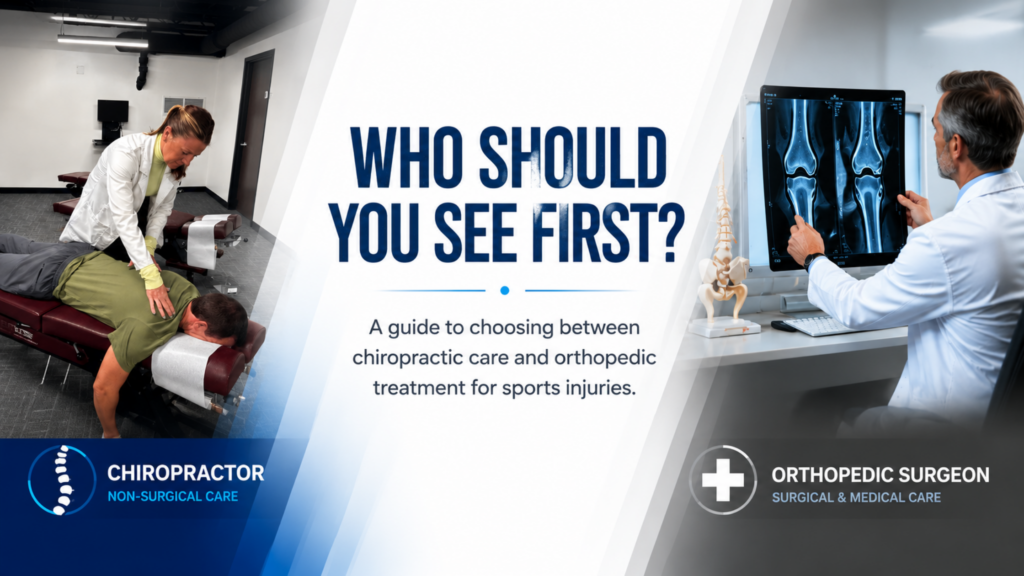
Deciding between a Chiropractor and Orthopedic Surgeon isn’t about quality, it’s scope. Knowing which scope fits your injury saves time, money, & in many cases, unnecessary procedures.
Here’s how to make that call with your sports injury.
For most sports injuries, including muscle strains, joint sprains, overuse injuries, and disc irritation, a chiropractic sports medicine provider is the right first call.
For suspected fractures, complete ligament tears, acute dislocations, or injuries that have not responded to 6–12 weeks of conservative care, an orthopedic surgeon is the best next step.
Main Differences Between Sports Chiropractors and Orthopedic Surgeons
The most common misconception about who should treat your sports injury is that it’s about severity: chiropractors handle minor problems and orthopedic surgeons handle serious ones.
But that’s not how it works in practice.
A chiropractic sports medicine provider, particularly one holding a Certified Chiropractic Sports Physician (CCSP) credential, is trained to assess, diagnose, and treat the full spectrum of musculoskeletal sports injuries without surgery. Their toolkit includes:
- Movement repatterning
- Rehabilitative exercise protocols
- Spinal and extremity adjustments
- Soft tissue therapies like myofascial release and instrument-assisted mobilization
The goal is restoring function through conservative, hands-on care and identifying when a case requires a different level of intervention.
An orthopedic surgeon is a medical doctor (MD or DO) with residency training in the musculoskeletal system and the surgical skills to repair structural damage, such as fractured bones, ruptured ligaments, torn tendons, joint replacements.
Orthopedic surgeons don’t only perform surgery. Many evaluate injuries conservatively first and refer to rehabilitation when surgery isn’t indicated.
Their primary value-add is in cases where imaging, injections, or surgical repair is genuinely necessary.
If You Want a Quick, Straightforward Answer Who to Call for a Sports Injury…
- A chiropractic sports medicine provider is built for conservative-first management and return-to-sport rehabilitation.
- An orthopedic surgeon is built for structural diagnosis and repair.
Most sports injuries fall into the first category. Some require the second. A small number requires both.
Which Sports Injuries Can Be Treated With Chiropractic Sports Medicine?
Top-Rated Chicago Doctors of Chiropractic Sports Medicine
Chiropractic sports medicine consistently produces strong outcomes for the injury types that make up the majority of sports-related presentations.
Muscle strains and ligament sprains. The most common sports injuries by volume – respond well to soft tissue therapy, joint mobilization, and progressive loading protocols.
Overuse injuries. Like IT band syndrome, patellar tendinopathy, and rotator cuff tendinopathy tend to be movement and loading problems at their root, which is precisely what a sports chiropractor is trained to address.
Disc-related back pain with single-leg nerve symptoms. The kind that shows up in runners, cyclists, and court sport players responds well to conservative spinal care in a significant majority of cases, without imaging or surgical consultation.
Starting with chiropractic sports medicine in these scenarios tends to produce faster return-to-activity timelines, lower overall cost, and avoidance of the imaging and specialist queue that adds weeks to the process.
It also provides a clear baseline assessment, so if the injury doesn’t respond as expected, there’s clinical documentation to support an appropriate referral.
When Does My Sports Injury Require an Orthopedic Surgeon?
There are injury patterns where going straight to orthopedic evaluation is the right call. Being honest about these is more useful than routing every case through conservative care first.
Suspected fractures require imaging and orthopedic evaluation. If you can’t bear weight after an ankle injury, if there’s visible deformity after a fall, or if pain is significantly worse with any weight through the limb, an orthopedic evaluation is warranted before anything else.
The same applies to acute dislocations (shoulder, finger, patella). Your joint needs to be assessed and potentially reduced under appropriate supervision.
Complete ligament tears are a more nuanced category. A full ACL rupture that requires rotational stability to return to sport, for example, often warrants surgical reconstruction, though the current evidence suggests this decision is more complex than it used to be, and many patients do well with conservative management depending on age, activity level, and instability pattern.
A traumatic rotator cuff tear. Especially if it is caused by a fall or acute mechanism rather than gradual degeneration warrants early orthopedic consultation. The pathway is different from a non-traumatic overuse presentation of the same structure.
Neurological red flags also warrant urgent evaluation: bilateral leg weakness or numbness, loss of bladder or bowel control, or rapidly progressing weakness are symptoms that need assessment beyond conservative care immediately.
Quick-Reference: Which Provider Fits Your Situation
| Situation | Start with Chiro Sports Medicine | Go Straight to Ortho |
| Injury type | Muscle strain, sprain, joint dysfunction, overuse, disc irritation, nerve tension | Suspected fracture, complete ligament rupture, acute dislocation |
| Timeline | Injury within 72 hrs, no trauma mechanism | High-impact trauma, fall from height, collision |
| Symptoms | Pain, stiffness, restricted movement, nerve symptoms in one limb | Inability to bear weight, visible deformity, severe swelling, bilateral nerve symptoms |
| History | No prior surgical intervention, first episode, responds to rest | Prior failed conservative care (6–12 wks), post-surgical follow-up |
| Imaging needed? | Often not needed initially | Yes for fracture, structural tear, or surgical planning suspected |
‘Shouldn’t I Just Go Straight to a Specialist?’
Some of our patients have asked: “If an orthopedic surgeon can handle everything, why not start there?”
The reason is because most orthopedic evaluations for soft tissue sports injuries (strains, sprains, overuse presentations, disc-related back pain) result in a referral to physical therapy or rehabilitation.
The surgeon confirms nothing structural requires repair, and routes the patient to conservative care. That process takes weeks and costs significantly more than starting with a sports chiropractor who can begin treatment on the same day as the assessment.
There’s also an evidence argument. Clinical guidelines for conditions like rotator cuff tendinopathy recommend against early imaging and support conservative rehabilitation as the first-line intervention, with orthopedic referral indicated only after 12 weeks of failed conservative care.
For lumbar disc-related pain, the evidence consistently supports conservative management producing outcomes comparable to surgery in the majority of non-emergency cases.
Going straight to a specialist makes sense when the injury pattern clearly indicates structural damage. For everything else, starting with a sports medicine provider who can accurately assess whether that threshold has been reached is the more efficient path.
Starting with a Sports Injury Assessment
The most common reason people delay care is uncertainty, not knowing whether what they’re dealing with warrants a specialist, imaging, or simply a structured rehab plan.
A sports injury assessment at Advanced Spine & Sports Care in Lakeview answers that question directly. Dr. Jason Ingham and Dr. Erin Schey evaluate the injury, identify what’s actually driving the problem, and provide a clear clinical picture including whether orthopedic referral is warranted. You don’t have to guess which door to walk through when someone can tell you which one fits.
Schedule a sports injury assessment at 2828 N Clark St in Lakeview today.
Last Updated on July 28, 2026 by Chiropractor Dr. Jason Ingham DC, CCSP