


Pickleball Back Injury Main Causes
Pickleball combines explosive lateral movement, repeated spinal rotation, and low-to-the-ground ball retrieval, which puts consistent demand on muscles and joints that most recreational players haven’t trained specifically for.
If you’ve recently suffered from a pickleball back injury, one of the key factors as to why lies in repetition.
Why Pickleball Is Harder on Your Back Than It Looks
Pickleball might seem like a back injury is the last thing you’d expect. The court is small, there’s no contact, and the pace feels manageable, especially compared to tennis.
However, the movement demands of pickleball are more repetitive rather than explosive. Every rally involves some combination of lateral shuffle, forward lean, rotational swing, and a quick reset back to ready position. Over a two- or three-hour session, that sequence repeats hundreds of times.
Which is where the problem starts: your lumbar spine absorbs a significant share of that cumulative load.
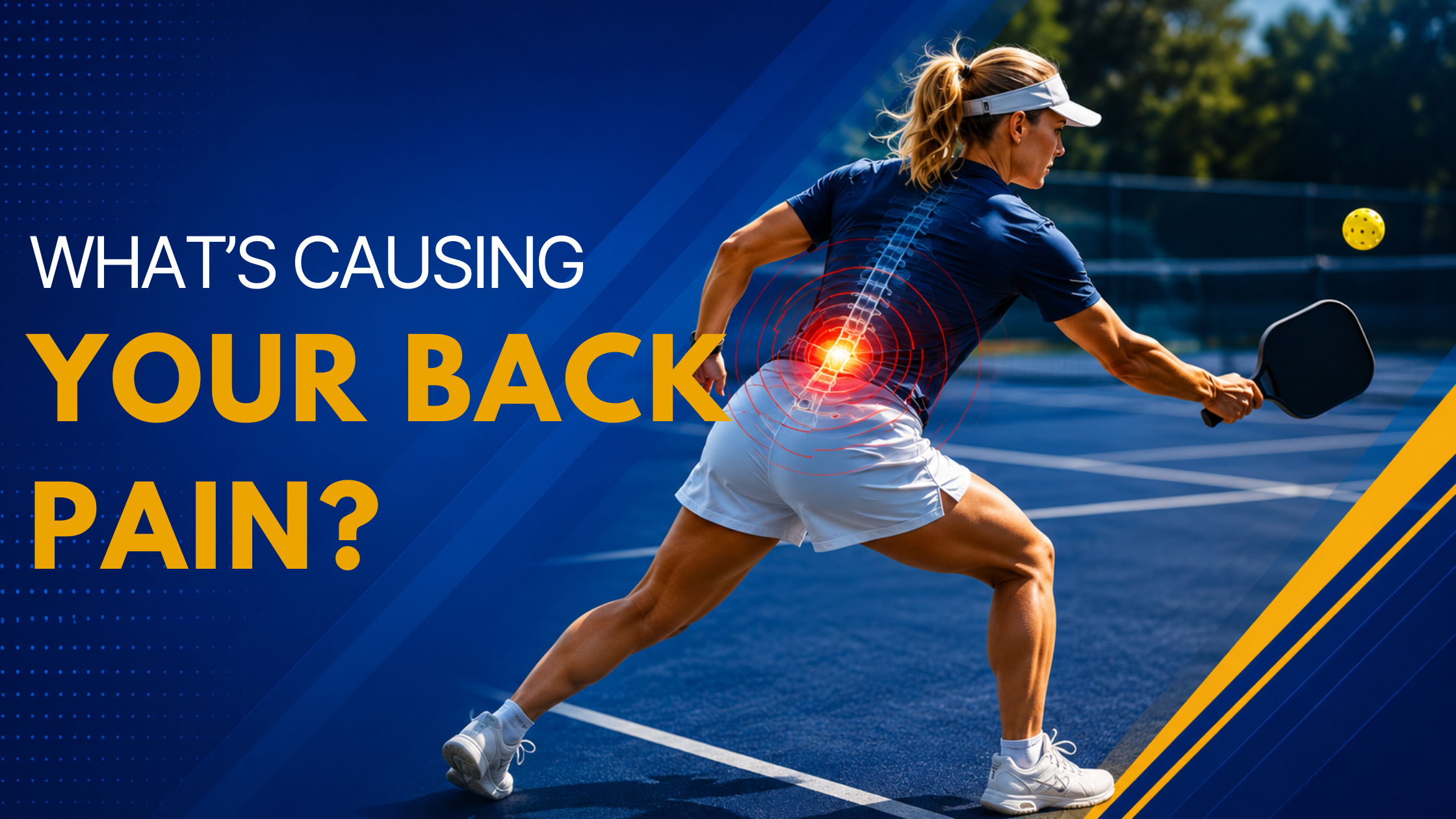
Where The Back Injuries Occur Most
The dinking game — the short, controlled exchanges at the non-volley zone — is where a lot of back problems start.
It looks easy. But to play it, you’re bent slightly forward for long stretches, holding a ready position that puts constant low-level strain on the muscles running along your lower back. Hold that position long enough and your muscles fatigue. When they do, your discs and the small joints between your vertebrae take over the load, and unlike muscle, they don’t bounce back quickly.
Every groundstroke and overhead shot adds a different layer.
Each swing involves twisting your torso, and if your mid-back is stiff, which is common in adults regardless of what they do for work, that rotation doesn’t happen where it should. Instead, it transfers down into your lower back, which isn’t built for repeated twisting under load. Over the course of a two-hour session, that’s hundreds of reps of pressure stacking on the same structures. That’s not bad luck. That’s just how the injury builds.
A 2025 study published in the Journal of the American Academy of Orthopaedic Surgeons found that pickleball-related spine injuries increased 56-fold between 2013 and 2023, with the lumbar spine accounting for 84% of all cases. The average injured player was 62 years old. That statistic isn’t a reason to stop playing, it’s a reason to understand what’s happening and do something about it.
Back Injuries from Pickleball: Common Causes, Symptoms, & Treatments
Back injuries are among the most common musculoskeletal conditions affecting pickleball players. While discomfort can occur anywhere along the spine, injuries most frequently develop in the lower back (lumbar spine). The lumbar region supports most of your body weight while allowing the twisting, bending, and rotational movements that are common during pickleball play. Repetitive stress, sudden directional changes, and improper movement mechanics can place significant strain on these structures.
Common Types of Back Injuries in Pickleball Players
Muscle and Ligament Strains
Muscle and ligament strains occur when the soft tissues that support the spine become overstretched or torn. In pickleball, these injuries often result from sudden lunges, quick rotational movements, reaching for a difficult shot, or poor lifting mechanics when handling equipment.
Herniated or Bulging Discs
Intervertebral discs act as shock absorbers between the vertebrae. Repetitive bending, twisting, and high-impact movements can contribute to disc injuries, particularly in the lower back. When a disc bulges or herniates, it may irritate nearby nerves, causing pain, numbness, tingling, or symptoms that radiate into the hips or legs.
Spinal Joint Irritation
The facet joints of the spine help control movement and stability. Frequent twisting and extension movements during pickleball can irritate these joints, leading to localized back pain, stiffness, and reduced mobility.
Vertebral Stress Injuries and Fractures
Although less common, direct falls on the court can result in vertebral injuries, especially among older adults or individuals with decreased bone density. Prompt evaluation is important when significant pain follows a fall or traumatic impact.
Why Chicago Pickleball Players Develop Back Pain
Back injuries can occur from a variety of factors, including:
- Sudden twisting or rotational movements during play
- Repetitive serving, reaching, and overhead shots
- Poor warm-up routines or inadequate flexibility
- Weak core muscles and reduced spinal stability
- Falls or collisions on the court
- Prolonged sitting between matches or throughout the workday
Sports Chiropractic Care for Pickleball-Related Back Injuries
At Advanced Spine & Sports Care, our chiropractic team evaluates the underlying cause of back pain rather than simply treating symptoms. Comprehensive care may include chiropractic adjustments, soft tissue therapy, corrective exercises, mobility training, and sport-specific rehabilitation designed to help pickleball players recover safely and return to the court with confidence.
When to Seek Professional Evaluation
While many back injuries improve with conservative treatment, certain symptoms require prompt medical attention. Seek professional evaluation if you experience:
- Severe or worsening back pain
- Significant weakness in the legs
- Loss of balance or coordination
- Symptoms following a fall or traumatic injury
- Pain that radiates into the legs
- Numbness or tingling sensations
Early diagnosis and treatment can help prevent minor injuries from developing into chronic conditions and support a faster return to your favorite activities.
Who’s Most at Risk of Pickleball Injuries?
Playing pickleball doesn’t automatically mean you’re going to get hurt. The real danger comes from doing too much, too soon.
Why Deconditioned Adults Get Hit Hardest
The typical pattern looks like this: you discover the sport, fall in love with it, and go from zero to playing four or five days a week in a matter of months. Your cardiovascular system adapts reasonably quickly, but your musculoskeletal system—the tendons, discs, facet joints, and supporting musculature—does not.
Connective tissue and spinal structures condition slowly. Push them faster than they can adapt, and something gives. Deconditioned adults are also more likely to be carrying the specific challenges that make pickleball dangerous:
Weak glutes and core
Reduced proprioception (body awareness)
Limited thoracic rotation (mid-back stiffness)
Tight hip flexors from years of sitting
When the hips are stiff, the lumbar spine compensates by taking on rotational demands it isn’t built to handle. When the core is weak, the spine has no stable base to rotate from.
These aren’t age problems. They’re deconditioning problems. And they’re fixable.
The risk isn’t pickleball itself. The risk is jumping into pickleball without preparing the body for what the sport actually demands. The risk isn’t pickleball itself. The risk is jumping into pickleball without preparing the body for what the sport actually demands.
How to Prevent Pickleball Back Injuries
Here’s what consistently makes the difference for pickleball players dealing with back issues.
Warm Up With These Spine Exercises
Start with a light jog or brisk walk to get blood moving, then spend a few minutes on mid-back rotation before you pick up a paddle. For spine exercises, these provide an excellent stretch to help your spine remain flexible throughout:
- Kneeling Thoracic Rotations with Wall
- Side Lying Thoracic Rotation with a Foam Roller
- Table Top Thoracic Rotation with Hand Behind Head
Any one of them takes under a minute and directly targets the stiffness that loads your lower back during play.
Work on Hip Mobility Off The Court.
Tight hips are the single most common reason recreational pickleball players develop back pain.
When your hips don’t move freely, every swing and shuffle step forces your lower back to pick up the slack. Five minutes of daily work makes a real difference over weeks by doing these two simple exercises:
Both are good starting points that double as warm-up and recovery tools depending on when you do them.
Train Your Core to Hold, Not Just to Crunch.
Pickleball doesn’t need a gym-strong core. It needs a core that can keep your spine stable while the rest of your body is moving fast in different directions/repeated motions.
Crunches, however, don’t train that. Planks, dead bugs, and carries do. Along with one simple exercise:
It builds the kind of segmental control your spine needs when you’re loading and rotating at the same time.
Respect your recovery time.
Playing more days doesn’t mean getting better faster. Your muscles adapt quickly, but the discs, joints, and connective tissue in your spine recover on a much slower timeline.
Two or three sessions a week with real rest in between will build your game more reliably than five days a week with accumulated soreness.
For post session stretching, try this:
The Prone Lumbar Extension is a good post-session wind-down that takes under a minute and helps decompress the lower back after a long session on the court.
Why Does My Body Hurt So Much After Playing Pickleball?
Various back discomfort after pickleball is normal.
Muscle soreness in the paraspinals, glutes, or hips during the first weeks of a new playing schedule is your body adapting. That kind of soreness is dull, diffuse, and resolves within 24 to 48 hours.
Symptoms are worth paying attention to:
Pain that persists beyond 72 hours after a session. Or that gets worse with each outing rather than better, suggests something beyond normal muscle adaptation. Persistent pain that doesn’t respond to rest is the clearest early signal that load management alone won’t resolve it.
Sharp, shooting pain that travels down one leg. Often described as sciatica, this indicates possible nerve root irritation. Sciatica happens when a disc shifts under repeated rotational load and presses on a nerve. It’s one of the most common presentations in pickleball players, particularly those playing three or more hours per session.
Numbness or tingling in the leg, foot, or groin. A neurological symptom that warrants evaluation. These symptoms suggest the spine is involved beyond the muscular level.
Pain that wakes you up at night or is present at rest. Not just after a pickleball session, but is outside the normal pattern of sports-related muscle fatigue and should be assessed.
Playing through any of these symptoms tends to compound the problem. Most disc irritations and facet joint injuries respond well to conservative care when they’re addressed early. The same injuries, left to accumulate over months, take significantly longer to resolve.
Learn more about the sports injuries we treat at Advanced Spine and Sports Care.
Sign-Up for Your Sports Assessment at ASSC in Lakeview/Lincoln Park, Before You’re Forced To
Most of the players we see with pickleball-related back injuries waited too long. What started as manageable soreness became a disc irritation. What could have been addressed in a few sessions became a multi-month recovery.
A sports injury assessment isn’t just for people who are already hurt.
It’s for active adults who want a clear picture of where their movement patterns break down before those patterns cause an injury. At Advanced Spine & Sports Care in Lakeview, our sports injury assessments identify the specific deficits, hip mobility restrictions, core stability gaps, and thoracic rotation limitations that put pickleball players at risk. From there, we build a plan around keeping you on the court, not pulling you off it.
If your back has been talking to you after sessions, now is a good time to listen. You can reach us at 2828 N Clark St in Lakeview, or schedule a sports injury assessment online.
Last Updated on June 25, 2026 by Chiropractor Dr. Jason Ingham DC, CCSP